Hi folks, I’m going to briefly cover some concepts that are helpful to understand when driving loads directly with PV DC solar panels: whether it is a fan, a heating element, an electric pump, hot water heater, and so on.
We will use a heating element for this example because it’s simple and has no complicated electronic circuits – and no need to calculate inductance for normal use cases.
(If you are interested, I have also produced a video on this topic which is linked below. )
Impedance Matching
The number one problem faced when driving a load from a solar panel directly, is impedance matching. Let’s use a simple resistive heating element as an example load.
Impedance means resistance to current flow.
Impedance, or Resistance, is measured in ohms.
Note: solar panels also have resistance, called internal resistance, much like batteries do. But solar panels have a relatively high internal resistance. This is why the voltage range is so wide and the voltage drops under any load.
Ohms Law Formula
In order to drive resistive heating element loads directly from solar panels, it is helpful to understand what is called ohms law. I call it ohms formula, because calling it a LAW simply blocks a person from thinking outside the box and doing any further investigation.
The formula works great for normal electric work. There are times and places where Ohms formula simply doesn’t work, but that’s outside the scope of this presentation.
Let’s continue with the example of a resistive hot water heater element. If you connect solar panels straight to the element, a voltage will be applied and some current will flow.
But this is governed by the voltage of the solar panel, and the impedance (resistance in ohms) of the element.
Ohms Law Formula – Simple Math
We can use a simple forumula to estimate the performance of the solar panel and heating element.
Before starting, it’s important to know what the solar panels you’re using are actually capable of for power output. You need to know what their maximum power point voltage generally is under operation, and what the current (amperage) output is. It might be different in winter versus summer.
For this example, let’s say in good conditions our solar panels @ MPPT are known to put out 45V at 10Amps, or 450 watts. This math will change if you change the panels, for example by upgrading them or adding some extra panels.
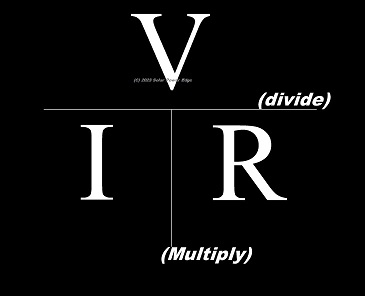
I’ve found it’s a great idea to go ahead and calculate the ideal impedance (resistance in ohms) of the load beforehand. For the example, how many ohms would we need the heating element to be, to get about 450 watts?
By looking at the chart (see image on this page) we can see that R is the quantity we want, that leaves V “on top of” I, so we will divide V by I to get R.
We use the simple formula: R = V/I
So 45 Volts over 10 Amps: we get 4.5 ohms
So our HWH element ought to be 4.5 ohms when hot.
Other Variables
But here is where it gets tricky. The following points should be kept in mind:
1) The element will probably increase its resistance as it heats up. How much depends on the type of element.
2) The solar panel will vary its performance based on temperature, age, time of day, and season.
Therefore it’s probably best to slightly unload the panel. This means choose an element that is slightly higher resistance and so a bit less power than the panels maximum power output, to give some headroom.
Here are some additional points to keep in mind, if the heating element has a higher resistance, it takes more voltage to drive the same current through it.
If it has a lower resistance, and current flows more easily, so less voltage is required to flow the same current. Keep the voltage the same, and lower the resistance, you get more current and therefore more power.
All of this can be mathematically calculated using the formula given, at least up to a point. Calculations on paper do not necessarily reflect the real world, but they are a good start.
It’s all interrelated. If your heating element resistance is too low and is drawing too much current, it will pull the solar panel voltage down below their maximum power point, maybe even to near zero volts. So to drive a heating element directly from solar panels with good results, one must properly match the impedance of the heating element to the solar panels. It’s simple math.
What Can You Do with Solar Panels and Ohms?
One of the most useful things you can do with the knowledge presented here is to run heating loads directly off solar panels. It is clean, efficient and within reach of most DIY solar power enthusiasts. The voltage should be kept at or below 48V nominal for DIY purposes, because higher DC voltages are dangerous.
As of now, I use several direct PV solar electric space heaters to heat various rooms in my home. I’ve been doing this for years with great success. I wish this technology was more commonplace. Hopefully in the future, direct PV DC solar heaters will be available on the store shelf.
More Stuff on my YouTube Channel
I hope you enjoyed this article. If you like this type of content, please check out my YouTube channel, we have over 90 videos and counting. Topics include solar power, electronics, DIY, and more on the way. Thanks for reading and have a great day! -DD
- Budget Friendly! 12V 2000W Sine Inverter: Full Test, Analysis, Teardown Insights
- Behind The Scenes in 2025, A Lesson In The Reality of Solar: Running TWO Freezers Off The Electrical Grid
- Explore The Future of Solar: Pure DC! Off Grid Residential Power With No Charge Controller or Inverter
- Heating A Well House With Simple Clean Solar Electric Power! Thermal Energy Storage / TES
- PV2L-MG: My Low Voltage DC Residential Micro Grid Goes Live! Direct Solar Photovoltaic
 Solar Thoughts blog