PART 1 AND PART 2 | Solar PV DC Heating for Beginners
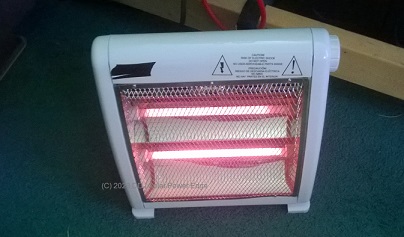
This blog post is a continuation of my Solar Electric Space Heating series. Since 2022 I have been converting commodity AC space heaters to direct Solar PV DC operation. This follow-up blog post has links to all of my video presentations on this project: initial prototype demo, conversion and modification of a space heater to PV DC operation, and now Part 3 – modification of internal safety controls for PV DC operation.
Its purpose is to help DIY solar power enthusiasts who want to build their own solar electric space heaters overcome certain safety problems that AC heaters cause if not converted properly to handle DC (direct current) from a solar array. Electronic controls and arc protection would normally be a must, but this is too complicated for many DIY’ers. So for almost a year I have been searching for alternative ways to make these heaters safer to use and avoid the complex electronics.
Before 2022, I used Car/Truck cab heaters and more recently PTC (Positive Temperature Coefficient) heater elements to heat my home with excess solar power. But I finally settled on converting AC space heaters to PV-to-load Low Voltage DC operation, mainly because I didn’t want to hear a fan running in my heaters. My converted space heaters are quiet, easy to use and reliable. Also I thought such a thing (direct solar powered space heaters) ought to exist, and when I can’t find something on the store shelf, I sometimes build it myself.
To learn more about this topic in more detail: Click here to see my Part 3 YouTube presentation of this topic which runs over 15 minutes.
Parts List for this project: note these are affiliate links, if you use them I earn a small commission. If you don’t wish to use them, just search your favorite website for the same item.
16A 42V DC tilt switch (tip over switch) https://amzn.to/46idwFk
Langir standard DC Solar Photovoltaic circuit breakers https://amzn.to/45b91el
Benefits of converting AC space heaters
My converted DC space heaters only need 2 skinny wires to heat a home or shop space. This is another kind of efficiency, when compared to solar thermal for example which gives potentially more heat, but can only heat, tends to be more complex and is not as versatile. Plus solar panels can run other loads when heating is not required.
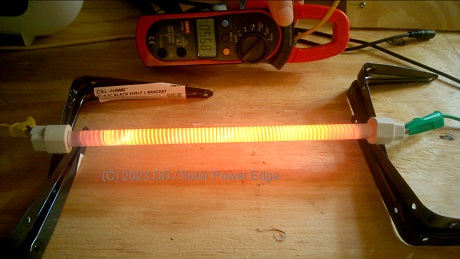
Benefits of PV DC solar electric space heaters include:
NO inverter, NO battery, NO high end electronics, NO high voltage. They are simple, robust and use commodity hardware that’s available cheaply all over the world.
Turning excess PV solar capacity into heat for my home? Yes, I’ll take it. Rather than letting solar panels age in the sun while under-utilized, why not use them for heat.
Safety Risks – Understanding AC vs DC
But converting AC heaters to DC has safety risks, and one must certainly put on their engineering hat and do the necessary research – otherwise a house fire could be the result. One of the biggest risks is the fragile AC (Alternating Current) rated switches inside most heaters. They are not rated for DC (Direct Current) operation and are vulnerable to arcing.
AC alternates in polarity 50-60 times per second (50Hz or 60Hz), so the arcing behaves differently and AC switches are able to withstand it. This is why many switches are rated for AC at high voltages, but lower voltage for DC, and sometimes have no DC rating at all.
DC does not alternate, and the current wants to “keep going” to put it in simpler terms. Thus when working with voltages about 30-55Vdc, arcing becomes a
concern.
DC through AC-rated switches
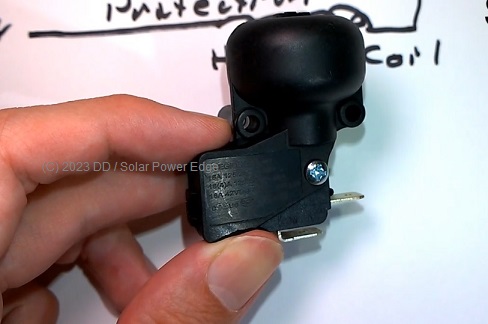
There is a very high risk in running Solar Photovoltaic DC through AC switches, particularly the tip-over switch (turns the heater off when if it falls over) and the overtemperature thermal cutout (turns the heater off if it gets too hot – much like a thermostat). Either of these protective devices could weld shut or “stick closed”, resulting in a house fire.
I have tested AC switches in these heaters with DC voltages over 45V. The arcing was so powerful it sounded like water spraying against a metal sheet. I already knew what would happen. The experiments just helped confirm it.
The search for a simple solution
In order to help DIY solar power enthusiasts who want to build their own custom PV-to-load DC heaters, I looked for a long time for a way to mitigate the previously mentioned risks in a simple electromechanical way. I know many DIY solar power enthusiasts don’t want to get into electronics. But the ideal solution is a microprocessor controlled circuit with MOSFETs to monitor the heater and shut it off during a tip-over event or if anything goes wrong.
Solid State Relays – Good or Bad?
I get a lot of questions about Solid State Relays: wouldn’t they be ideal for switching the DC load into the heater? The answer for me and my household is NO. The SSRs widely available are well known for failing. They are actually just power transistors with a simple circuit closed up in a box, and a heat sink because they tend to get hot. They are not very sophisticated.
The problem is when they fail (and they do often) the failure mode can be a SHORT CIRCUIT. That means it’s “stuck on” and could not be turned off. You’d have to unplug the heater from the power source or cut the wires to disable it. I am not willing to cause a fire because of a cheap SSR, no thanks. With proper electronic circuitry there are workarounds, but again, most people don’t want to work with electronics in their projects, and so it creates a barrier to DIY’ers.
After some research, I arrived at a half decent solution allowing a person to experiment with low voltage solar PV DC electric heating while enjoying a reasonable safety margin. I present some of those ideas here and in this video.
Problem #1 – turning the heater on and off
The solution is very simple, just use a standard Solar Photovoltaic rated circuit breaker. I have done this for years even before I started using converted AC space heaters. I did the same with car/truck cab heaters and PTC heating elements used to heat my home with solar panels (videos posted below). These PV circuit breakers can handle and extinguish DC arcs easily, and are rated for thousands of on/off cycles.
Problem #2 – tip-over safety protection
If the heater tips over, there is a small AC-rated switch usually that opens to turn off the heater before it sets the carpet on fire. But that switch can arc and fail when subjected to a DC solar photovoltaic open-circuit condition. A potential solution is to place 1 or 2 DC-rated “tilt switches” in series (links are above), with or without the existing tip-over switch in the heater.
Deploying 2 or more tilt switches in series will give what I call “guaranteed circuit interrupt” in the event of the heater accidentally falling over. Even if there is arcing, it is highly unlikely with multiple switches opening that the heater will not be safely disabled. Plus as a rare bonus, the switch linked above does have a DC voltage rating for up to 42V, very close to what my heaters can operate at.
Problem #3 – over temperature thermal cutout
These devices are installed in many heaters and are very similar to a thermostat. If the heater gets too hot, they go open circuit turning the heater off. However, they are not necessarily DC rated. The solution is again to place more than one in series, guaranteeing circuit interrupt during an overheating event. For further protection, I recommend placing a properly rated one-time-use DC-rated thermal fuse in series. If the heater gets too hot, it will disable itself and require service to continue using.
Learn More
This article serves as a brief overview of the Part 3 video production. Further details about my solar electric heating projects are available on my YouTube page. Some of those videos are linked below.
I hope to further develop my solar electric PV heaters in the future and produce a few more videos on the topic. And perhaps someday we will see these heaters mass produced and on the store shelf.
I hope you enjoyed this blog post, thanks for reading and see you later – DD
 Solar Thoughts blog