Introduction and Recap of Past Work
Over the past several years, I have experimentally heated my home and workshop with custom space heaters converted from AC to Direct DC operation. What I wanted to achieve was to plug my space heaters straight into the solar panels, bypassing inverters, charge controllers and batteries. Plus save wear on my heat pumps. In particular, I became rather fond of converting Quartz Tube infrared space heaters to direct DC solar photovoltaic operation, versus other heater types.
But I found rewinding Quartz Tube heating elements to be a somewhat tedious and potentially risky chore. Heating elements have to be rebuilt correctly, requiring understanding of Ohms Formula (aka Ohms Law), the ability to do math calculations, and a lot of other knowledge and experience. Heating elements that are not rebuilt properly can be dangerous, even starting a fire.
Before getting to this simple heater conversion, here are my thoughts and reasoning behind the project.
Motivated to save wear and tear on my heat pumps and GTI
The overall goal of these converted heaters was to stop using my heat pumps and Grid Tie inverters in the winter, instead depending on pure electric power straight from the solar panels for supplemental heat. Why couldn’t I just plug a space heater straight into my solar panels and be done with it? After building several converted heaters, I was able to meet the goal. The heat pumps and Grid Tie Inverters have had a good rest the past winter seasons.
Suitability of PV-to-Load Space Heater model
It is important to note that whether such a solar electric heating concept would suit a person depends on these factors, and possibly others:
- Local climate (how cold the winter gets)
- Quality and insulation (R-value) of the heated structure
- What other types of heat are available
- Available amount of disposable solar electric power
Regardless, even a single solar PV space heater can provide supplemental heat. In my situation, this worked out very well, allowing me to shut off my complicated and expensive heat pumps for the winter. Saving wear on them is very important to me.
Why I wanted to avoid running my Heat Pumps in Winter
Most homeowners don’t realize, heat pumps and their compressors run at very high pressures in heating mode vs. cooling mode. They have to work incredibly hard in winter conditions vs summer. It’s much harder to extract heat from cold air than to cool a space. Furthermore, I believe most homeowners with heat pumps couldn’t tell how much BTU (heat) per Watt they are actually getting – they are just assuming. The fact is, the colder it gets, the less heat there is and the more that machine has to work just to create heat.
Heat pumps are very expensive to repair and replace. In my view, it doesn’t make sense to use such complicated machinery simply to produce heat. It works better for cooling. The claims of getting far more heat per watt are offset by cost and complexity. I also aim for freedom and independence, and less calls to HVAC technicians certainly is part of that. Not to mention saving wear and tear means saving money.
A quick Description of PV-to-Load / PV2L
The idea of consuming DC power straight from a solar array with a directly attached appliance could be called PV-to-Load (PV2L for short). We take the load and connect it straight to the solar panels, saving wear and tear on all the expensive and lifetime-limited equipment normally found in between such as: the charge controller, battery bank and inverter. PV2L is a great way to dispose of excess solar power locally, rather than letting panels sit idle or exporting excess power through a grid tie inverter.
Harbor Freight Parabolic Infrared Space Heater
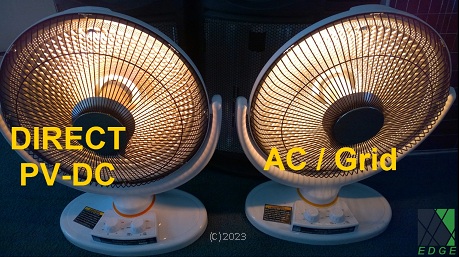
OK back to the heater conversions. In the process of converting many heaters to DC, I tended to also like Parabolic space heaters. One particular model caught my attention – it’s the Harbor Freight parabolic infrared space heater. I found this gem has a very interesting sealed heating element that can consume DC electrical power directly from a solar panel array. NO rewinding of the heating element is required at all, nor is it even possible.
The heating element in this HF Parabolic heater looks and acts very much like a light bulb, with low resistance until it warms up. It can handle sudden voltage swings on the solar array with no problem at all. About 55v DC (direct current) is enough to activate the heater and warm a small room or provide supplemental heat. No electronics, no wear and tear on an inverter, no high voltage, no battery cycling, no working an expensive charge controller just to generate heat. The total cost of such a conversion could be less than 100 dollars and maybe a handful of hours of labor.
DIY Conversion Project
After discovering the relative ease of converting this heater, I created a DIY video to share the idea with DIY solar power enthusiasts. I think those that are interested in solar electric PV space heaters (but understandably don’t want to rewind heating elements) will find this option more accessible.
Parts List for this project: note these are affiliate links, if you use them I earn a small commission. If you don’t wish to use them, just search your favorite website for the same item.
16A 42V DC tilt switch (tip over switch) https://amzn.to/46idwFk
Langir standard DC Solar Photovoltaic circuit breakers https://amzn.to/45b91el
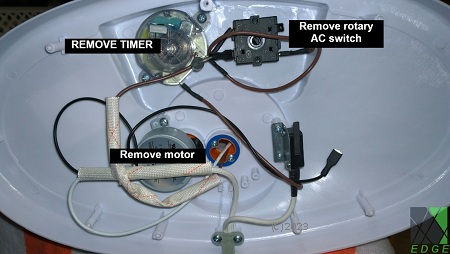
One only needs basic solar power and electrical knowledge, plus good common sense and the ability to keep safety in mind.
- The heater requires a proper solar photovoltaic DC rated circuit breaker to switch the heater on and off. Do not attempt to break DC through the tiny and fragile AC switches and knobs found in AC space heaters today – this is extremely risky and unsafe. These can heat up, melt and catch fire inside the heater. Remember a modified heater loses its UL listings and safety ratings as soon as you open it up!
- One or two DC-rated tip over switches (tilt switches) should be inserted in series with the heating element. Two switches in series greatly increases the voltage rating and interrupt capacity, as long as they are synchronized (meaning they go open circuit at the same time).
- An additional thermal over temperature protective device is highly recommended to reduce fire risk – a thermal fuse should do the job. If it blows, the heater would require attention and repair, as opposed to automatically resetting itself. That is the safety model I prefer. The existing thermal protection devices in space heaters tend to be the kind that automatically reset. But that could cause a fire.
- The existing AC switches, AC timer device and AC oscillation motor must all be disconnected and removed. They are not safe to use with DC voltages.
- Proper fiberglass jacketed wire with high temperature rating should be used for all connections. PV wire for the external connections. Don’t use solder in space heater power connections, only secure crimps. High temperature Silicone jacketed wire might be a good alternative, but I’d still use fiberglass wrap wherever possible.
More Safety Warnings
One should never try to repurpose the AC switchgear on an AC space heater to switch direct current from a solar array. This is extremely dangerous due to the challenges in interrupting a DC circuit – a totally different task from interrupting an AC circuit. The primary concern is the arcing behavior of DC, which tends to be a problem – especially with solar panels due to their open circuit behavior.
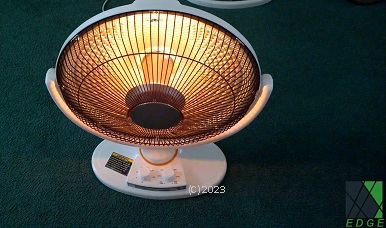
After doing up all the wires and connections, the heater runs smoothly off of the 55v DC solar array in my yard. It looks good, works good, it’s cheap, it’s simple to convert and very satisfying to use. Perhaps someday Photovoltaic DC space heaters will be available off the store shelf as commodity items. Who knows. For now we have to build them ourselves.
Check out my video below showing the heater in action plus conversion information. There’s also some links to other space heaters I have converted to PV-to-Load operation. In addition, my YouTube (Solar Power Edge channel) is packed with information about PV2L and solar power in general.
Warning
NOTE: I strongly advise against doing this kind of AC space heater conversion project unless you have a solid understanding of the technical aspects, safety, and fire risks involved. It’s not worth a home fire – don’t be careless.
If you’re not sure how to proceed, spend time researching the following topics – many are covered on my YouTube channel: basic electrical, PV solar power installation, Ohms Formula / Ohms Law, local fire codes, electrical codes and anything related to the engineering involved in such a project. Be safe!
Thank you for reading and I hope you enjoyed this blog post. Have a good day! DD, SPE
My PV-to-Load YouTube Playlist
My Inventions and Prototypes YouTube Playlist
My Solar Power for Beginners Playlist
My Solar Cooking Project Videos
 Solar Thoughts blog