Recently a company called Bateria Power offered to send me their 20A MPPT charge controller (SunRock 20pro) for review. I was not even aware it existed, so I decided to give it a try.
This unit is really small! It has no fans or moving parts, and appears to be totally sealed with an IP45 rating. It supports 300w of solar panels at 12v, 600w at 24v, and 30 or 60 VoC on the solar array at 12 or 24 volts. There is a bluetooth option with a smart phone app which allows option advanced configuration and monitoring. A simple one button interface allows quick setup in a minute or two. Lithium Iron Phosphate (LiFePo4) and AGM/Gel lead acid battery chemistries are also supported. The display is very simple showing basic information such as battery voltage, charging status and charge current.
Note: Bateria Power sent this unit to me. I was not financially compensated for the review. These are my own opinions.
Bateria Power SunRock 20pro purchase link – please note this is an affiliate link, I may receive a tiny commission if you use it – thank you 🙂
I also posted a video of my bench test and review of this charge controller on this page.
Where does this charge controller fit in?
Answer: anywhere a small, simple and robust charge controller is needed for mobile applications or small off grid setups.
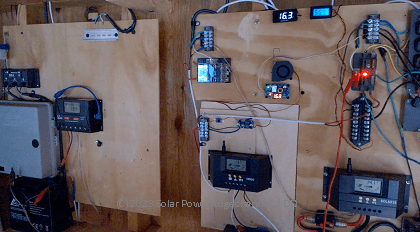
In my solar shed, I have a lot of mostly PWM style solar charge controllers. They tend to be simple and robust, but without MPPT. They do the job, but obviously waste some of the solar power due to the inefficiency of PWM. MPPT charge controllers can squeeze more watts out of a solar panel than PWM charge controllers.
Simple PWM controllers are great for camper vans, boats and small setups. The SunRock 20pro is apparently aimed at such setups. It has a simple one button interface, and changing the battery type takes only seconds. As such, it works well for mobile spot / field charging – for example automotive battery charging. The MPPT ensures you get a few more watts of power out of the same panel.
MPPT Bench Test
But lots of charge controllers and devices claim to have “MPPT”. The first thing I did was put the SunRock 20pro on my work bench and hook it up to a bench power supply.
With the suppy set to CC CV ~18v 1A, I did not actually expect the charge controller to be smart enough to figure it out. After all, it expects a solar panel on the input, which behaves entirely different from a bench power supply.
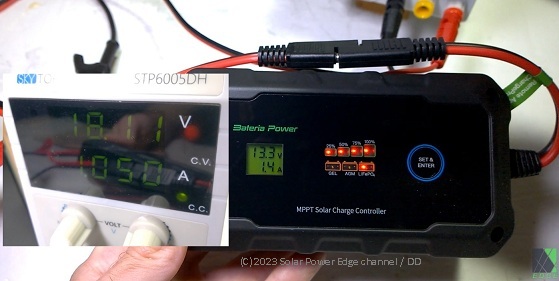
After connecting the charge controller to a battery and my bench power supply, it took about 30 seconds before the microprocessor apparently figured out the best voltage was – 18v at 1A. Exactly what my supply was set to. I was surprised. I reasoned if it was smart enough to figure out how to extract the power from my CC CV supply, it should handle a real solar panel under varying conditions just fine.
Initial Field Test
This charge controller has SAE connectors and reminds me of one of my favorite portable automotive battery chargers. I thought it would be very handy to have a 50 watt solar panel and this charge controller set up for charging my 12v automotive battery when needed – and no dragging out an extension cord.
By attaching my own SAE 12v plug to the controller, I was able to plug it straight into my cars 12v cigaratte lighter outlet. Add a solar panel, and within seconds it was charging my car battery. I saw about 46 watts on a 50 watt solar panel – which I hadn’t bothered to aim properly. That’s MPPT doing its job.
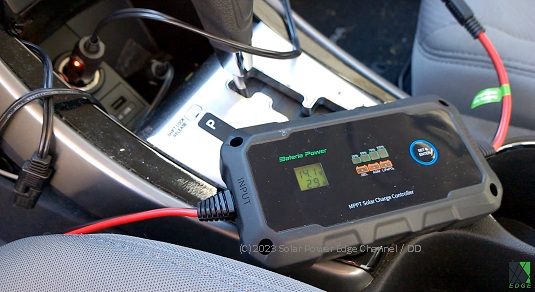
Also the sun happened to be going behind the clouds constantly. I was able to observe the controller reacting to this in real time, as it should.
Final Thoughts and Summary
After using this charge controller for a while, I can’t find a lot to complain about. The SAE connectors are not my favorite, but they are everywhere in the auto, RV and boating scene. Worst case, they can be removed and longer wires spliced in.
The wires coming out of the controller are not very long, so if one intends to cut the SAE connectors off, they should be careful because the unit is sealed and it cannot be opened to replace or lengthen the wires. Doing so no doubt would ruin the IP45 moisture protection rating.
The MPPT algorithm “actually works”, and seems intelligent enough to adapt to many changing circumstances.
In short, I can recommend it. The unit will be put to work long term doing field charging for my vehicles and also supporting mobile camera and field work outside.
I hope you enjoyed reading my review. If you want more details, the video posted on this page shows the actual testing. Thanks for reading and have a good day! DD, SPE
 Solar Thoughts blog