It’s happened, The Grid Is Down. Roads are closed. No gas stations are open. Nothing works. Electrical power and communications are gone. Chaos is slowly breaking out. But the Off Gridder feels fairly secure; solar panels on the roof, 20kw of batteries, a wondrous integrated inverter with bluetooth, MPPT charger all crammed into one giant metal box. It has the latest firmware, and an App with cool charts!! This is going to be fun! Right?
Along with a Grid Down scenario, this post will introduce the concept of Direct Solar Electric Cooking (PV-to-Load / PV2L model) and compare it to traditional models in a simple and straightforward way.
Background
The ability to cook food is often taken for granted in developed nations. It is critical for maintaining caloric intake and minimizing food spoilage. (Food that isn’t cooked in a timely manner can be lost.) Part of preparedness means understanding how to maintain a certain level of civilization, basic infrastructure and morale, while letting go of what is not absolutely necessary. Thus, as part of my preparedness strategy I have been seeking simple, robust and efficient ways to cook food with solar power. And that means breaking with traditional ways solar power is often used.
Direct Solar Electric Cooking means we connect the PV solar power voltage straight to the oven and food being cooked – batteries and charge controller become optional. Inverters, which are complicated and expensive, are no longer needed and perhaps can serve in a more limited scope with less wear and tear on them. I think this method of cooking sits between campfires and solar thermal and just below the traditional method (solar, battery, charge controller, inverter) yet it has many advantages over both ends of the spectrum.
This blog and my YouTube channel (Solar Power Edge) focus on new and emerging technologies and grid-down scenarios. I call it High Tech Survival – learning to use technology in a simple and effective way to survive future hardships and challenges, without it becoming a vulnerability or hindrance.
I don’t ever consider myself off grid. Everyone in a developed nation is on grid, including those who run their houses with batteries. Grid Down – is the real off grid! And it’s no fun at all. That’s when we find out what Off Grid really means. It’s hard work and suffering. And that is what I am preparing for and trying to warn others about.
Just to be clear, my house has a ton of Lithium Iron Phosphate batteries, powerful inverters, expensive charge controllers etc. and there is nothing wrong with that at all. But I don’t focus on it. DIY Solar Power is about learning to tap abundant God-given solar energy, and using such a gift wisely – not for ego or bragging rights.
Shortage of Kitchen Grade Low Voltage DC Cooking Appliances
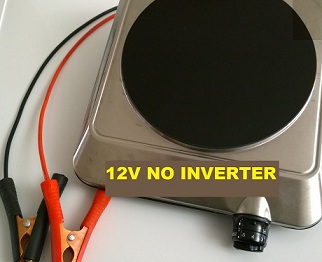
Affordable Low Voltage DC cooking appliances that are kitchen-grade are almost nowhere to be found. In my opinion, there is already a desperate need for them, especially in less developed nations. The people in those nations know full well how hard it is to get cooking done, sometimes food spoils and cannot be eaten because no cooking arrangements could be found.
I once witnessed poor (and hungry) villagers discarding relatively recently acquired meat. Why? They could not even afford a piece of coal or fuel to cook with. Things are not easy in some places. So they lost the food.
As of 2020, I could only ever find an assortment of low-grade low power 12v appliances, some serve as little more than “food warmers”. Not that there is anything wrong with that. However I believe in the future there will be an increasing need for simple, robust and high power cooking appliances that can consume DC power directly. For example, my pure 12v kitchen grade cooktop (hotplate) prototype is a good example.
Traditional Off Electric Grid cooking
Traditional off electrical grid cooking would mean connecting DC (direct current) solar panels to a solar charge controller, which in turn charges a battery with DC. The batteries then power an inverter which boosts the DC up to high voltage, then switches it rapidly through power electronics into 110/220v AC (alternating current). The AC can then power common off the shelf AC cooking appliances.
Convenience – the first problem with this model is that it is so convenient – no one thinks about how complicated and top-heavy such a method is. When the grid is up, many never even consider how sensitive and sophisticated these systems are. And how vulnerable they are.
I can’t run my AC stove top because the inverter has a red light and won’t stay on under heavy load. We still have a small freezer and a small inverter, but the food is cold and raw. A new inverter cannot be ordered, stores are closed. Even the internet doesn’t work anymore…
It is rare to find a person who can actually troubleshoot, let alone repair an inverter. Especially under challenging circumstances. Repairing complicated electronics under severe and challenging personal circumstances is something I have direct knowledge and experience with! Hint: it’s even less fun.
All the propane is used up, and with no grid we can’t get more. Hopefully, I can light a campfire and do some cooking, but fuel supplies are scarce. Everyone else is out scrounging for the same thing. I am nervous that the smoke will attract unwanted attention…
How will this affect morale going forward? Lack of cooking fuel is a fairly common problem in some places. Even in my area, wood sources are limited and a few cooking fires would quickly exhaust my local supply.
Fact: a couple of 100 watt solar panels can cook endless meals and serve many other needs as long as they are kept in good shape.
Efficiency losses – each conversion stage in the traditional model incurs a loss of power. For example, inverters and charge controllers get warm or even hot (that’s why they often have fans and almost always have heat sinks) and power loss is manifested as heat. Ironically, that heat could be used for cooking.
DC-AC Inverters can waste 10-20% of the DC power flowing through them. The actual figure varies wildly, but can be measured using simple electrical know-how.
MPPT Charge Controllers are not truly guaranteed to be more efficient than PWM, but almost certainly more expensive and complicated to repair. Many off gridders believe if they input a higher PV array voltage into the charge controller, that makes it “work better”. But that is so untrue. Perhaps I will delve into that topic another time.
In fact, it is possible in some cases a simple and cheap PWM charge controller can be more efficient than MPPT – because it merely connects the solar panels straight to the batteries through a diode. MPPT has the advantage of attempting to find and hold the most efficient solar array voltage, and for this one can gain more power. However, this gain is offset by switching losses in the power electronics.
In short, from the Charge Controller, to the battery, to the inverter, a significant amount of power is wasted. But it doesn’t have to be.
MTBF – Mean Time Between Failures. Inverters and Charge Controllers, due to their nature have the ability to run for so many thousand hours (hopefully) before a failure takes place. It might be a dried electrolytic capacitor, a cold lead-free solder joint, faulty power MOSFET, that unexpected surge from starting an air conditioner or inductive compressor load, the sky is the limit.
And did I mention the difficulty in repairing these devices? No, most people just buy a new one – they take it for granted.
I never take the grid for granted! It’s transportation, logistics, internet, fuel, communications, grocery stores, gas stations, propane, farms, doctors, road maintenance, services. It’s the underpinning of the society everyone takes for granted daily – including those who run their houses off of batteries.
Versus Solar Thermal
Ever since the grid went down, phones don’t work, no internet… roads are all blocked, grocery store is closed, the inverter is finally burnt out, I am desperate to cook food – while I still have some. And this morning we managed to catch some extra fish… can’t bear to see it lost to spoilage. What to do?
I am for any Solar Cooking methods, including solar thermal. Especially if it doesn’t generate smoke and attract a lot of attention. However solar thermal cooking usually refers to “boxes with mirrors” or a fragile glass tube that is hard to keep clean. It means you have to bring the food outdoors, stand in the sun, wind and bugs and brave the elements. These devices, while truly fascinating and functional, have many drawbacks.
Efficiency, a much misunderstood topic, is about more than what percentage of the sun (solar radiation) is collected to cook the food. It’s also about how much effort is required and how practical and flexible the cooking solution is to use in the real world.
Unfortunately, in all the research and testing I have done, many small portable solar thermal cooking devices are not very practical in today’s modern society. It seems people hearts are more centered towards “entertainment and pleasure” than towards preparation and survival. The smaller solar thermal cooking devices and various top heavy technological setups seem to cater to this crowd. There are certainly cases where solar thermal cooking is very helpful especially if there is no other choice. In some remote and austere regions I have seen it used pretty effectively but the systems tend to be non-portable. I like to use solar thermal cooking for a backup cooking method, and certainly as a last alternative to building a campfire.
The grid has been down for almost a year… we can’t communicate or travel. Food supplies are running low. I am worried about running my batteries too hard, because of the battery famine; we can’t get new ones. Thankfully, a few small solar panels survived, because I watch over them and take them in every night for safety. I wish we could just hook an oven straight up to the panels and cook without a lot of stress…
PV-to-Load / Direct Solar Electric Solves Problems
This is where direct solar electric comes in. A simple, flexible, portable, multi-voltage oven powered by any voltage source including direct DC solar power is worth its weight in gold. It can cook thousands of meals with zero fuel and virtually no costs. Maintenance is 100% possible and DIY. If the heating element burns out, it’s possible to repair or build a new one from scrap materials. There need not be any complex electronics or fancy circuits to operate such an oven.
Key Advantages of Direct Solar Electric Cooking
- A Pair of Wires Brings Cooking Indoors – while solar thermal requires the user to be outdoors with their food (and did I mention bugs, wind and sunglasses) direct solar electric cooking brings the cooking appliances indoors out of the elements. Cooking indoors is far more civilized and less likely to damage morale in the long term.
- Same familiar look and feel of standard kitchen appliances – because in the case of prototypes I have built, that’s what they are based on.
- Electrical Efficiency – Direct Solar Electric Cooking and PV-to-Load devices in general, waste far less solar power by transferring it directly into the work being accomplished – in this case, cooking.
- Elimination of Charge Controller / Battery / Inverter dependency – as long as one has a working solar panel, the oven can keep cooking meal after meal.
- Optional Battery Backup – a multi-voltage DC oven can still be powered by a battery if needed. But it is not mandatory and becomes more like a luxury.
Things are still tough ever since the grid went down, but we managed to construct a new type of small portable oven. It uses DC power, even directly attached to small 100 watt solar panels. So far we’ve cooked over a hundred meals in this oven, and our campfire is only a backup now. We managed to score a used inverter, but it stays off until we really need it.
Conclusion
I hope you enjoyed reading this blog post, and hopefully it will give you some food for thought. If you are interested, I am creating a variety of prototype direct solar powered ovens and cooking appliances, they are posted on this blog and on my YouTube channel. I also included a video on this page of one of my ovens being tested.
Thanks for reading, have a good day! -DD, SPE
Mini 18V Tool Battery Oven baking bread prototype
Mini 100w solar powered oven cooking chicken prototype
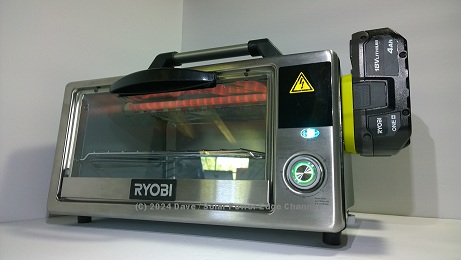
18V Ryobi tool battery / 12-24v/PV hybrid powered oven prototype
 Solar Thoughts blog
Comments
One response to “Direct Solar Electric Cooking vs. traditional methods – A Grid Down Scenario”
[…] ovens would be useful for hard times and Grid-Down scenarios (that’s the real Off Grid). There are places in the world where cooking is […]
LikeLike