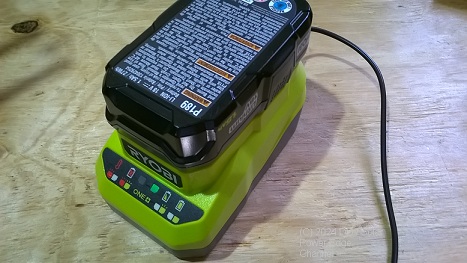
If there’s one thing that has changed DIY over the past few years, it’s cordless lithium ion powered tools. I use a lot of Ryobi 18v batteries to run tools and have become addicted to their flexibility and affordability. But the charger usually is plugged into an AC outlet.
Why not simply plug a solar panel straight into a cordless tool charger in the field? It makes a lot of sense for the current age, but also from a survivability perspective. If the grid is down and mobility is key, charging up 18v appliances without being tethered to a generator or larger solar battery system would sure be handy. Especially if the solar panel would plug straight into the charger – that’s direct DC solar power. No fancy setup or anything heavy.
So here’s my latest Ryobi 18v Solar Charging project – version 2.0!
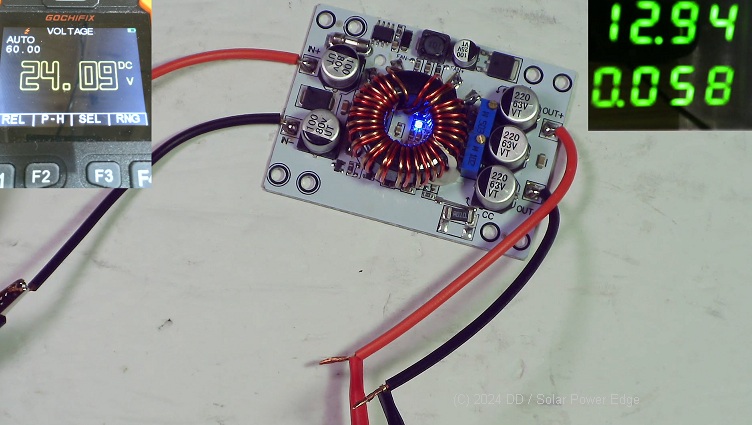
It is not the first time I have used direct DC solar power to charge power tool batteries. In 2022 I initiated the Solar Powered Ryobi 18v Battery charger project (see photos on this page, build videos are also linked toward the bottom of the article).
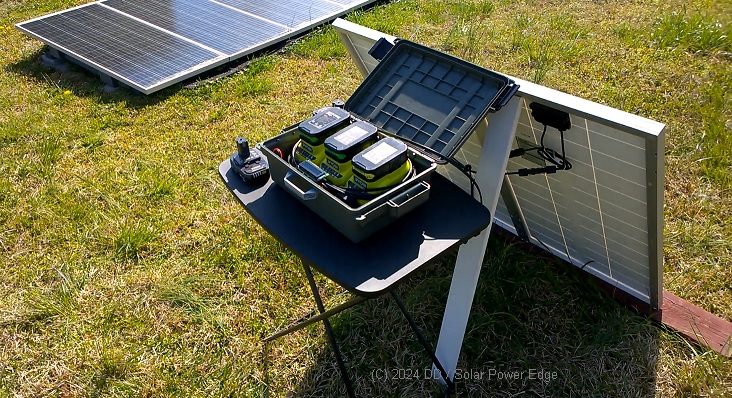
The first charger prototype could charge one 18v battery straight from a 50 or 100 watt solar panel. The overall cost was low, it was a very simple and compact design.
Recently I noticed Ryobi’s 8 port supercharger product. The price is a bit high and the model I saw charges 1 battery at a time out of 8 one after another automatically. It’s a really neat piece of engineering and looks great. But I was inspired to try building my own DIY supercharger powered by solar…
I started with a simple CC (Constant Current) CV (Constant Voltage) DC-DC Buck-Boost converter board which I am very fond of for solar projects. 3 of these boards should be able to push 100-200w+ into 3 18v tool batteries.
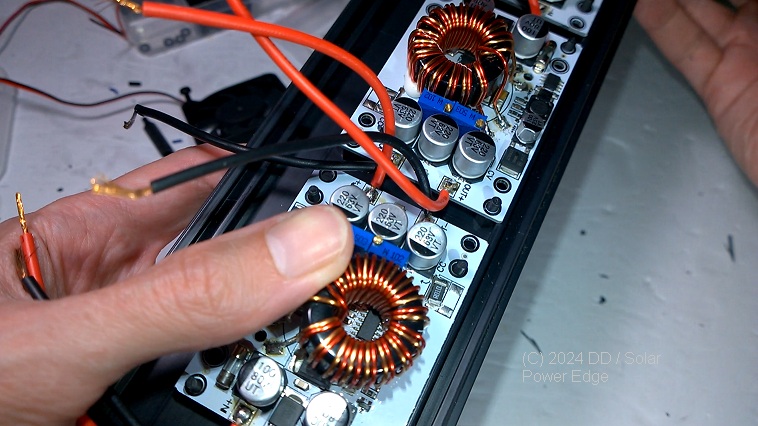

The boards were configured to regulate the solar panel voltage of 20-50v and output enough current to charge an 18v tool battery. They were mounted on a recycled plastic track. Because the charger will operate outdoors in the sun and summer conditions, I added 3 strong brushless DC fans. The inputs are fused and current is limited by the boards CC function.
The 3 DC converter boards can take a wide input voltage from 12 volts up to 50+ volts DC. This allows me to drive 3 Ryobi 18v chargers simultaneously from any DC source including directly connected solar panels or a simple car battery if necessary.
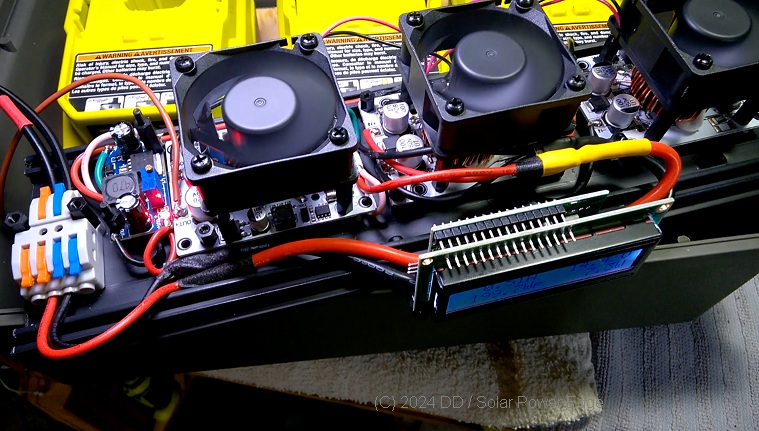
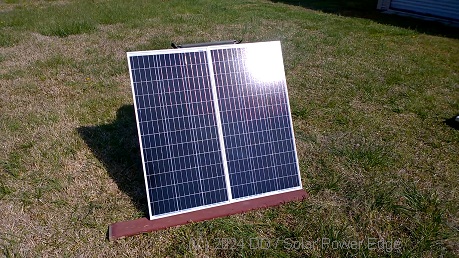
I was able to fit all the electronics and wiring into a compact carrying case, to which I attached a solid aluminum handle. The resulting charger is surprisingly lightweight and easy to carry. It runs all day for free, charging battery after battery from the sun.
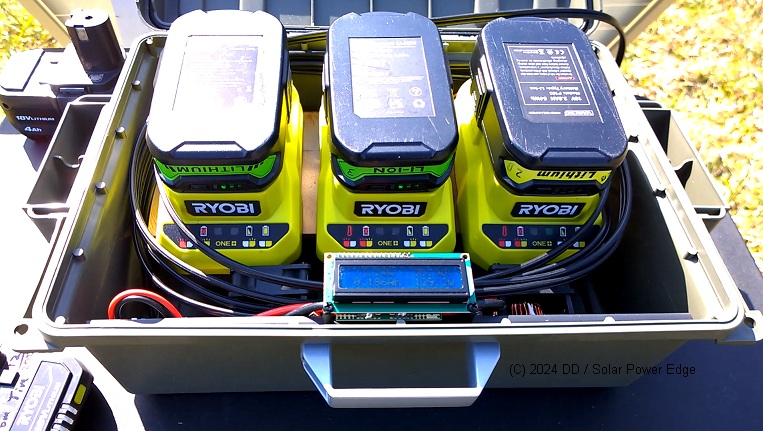
With the wattmeter it’s easy to see how much solar power is flowing into the system or if the voltage is dropping too low. I found this setup very effective and customizable. For example, output amperage can be adjusted using a trimpot on each DC converter board. Right now I have my chargers at 2 amps of current, which is more than enough. But there is no reason why the value could not be tailored to individual use cases.
As it stands, my super charger pulls about 136 watts from the panels while charging 3 batteries. It could easily push 200w or more. I may increase the power dissipation in the future after a few more rounds of charging, we’ll see… although I actually prefer to charge tool batteries at a calmer rate.
Hopefully this project will serve future charging needs for many years to come. Anyone can build this charger out of common off the shelf DC converters and parts. DC converters like this have low component counts, and with basic electronics knowledge are actually possible to repair in many cases.
For those who don’t want to build chargers, perhaps Ryobi will start producing solar powered equipment in due time. I believe there is a very strong market for this type of product.
Thanks for reading and have a good day! -DD, SPE
Reference #1 – Parts List
Note these are affiliate links, I earn a small commission if you use them to shop. It helps support my work – thank you 🙂
- Plastic Case – https://amzn.to/3J8HMIL
- CCCV DC DC Converter Options https://amzn.to/3vyev7e https://amzn.to/3Jc7Rqi https://amzn.to/4cNLg0G
- Ryobi PCG002 – https://amzn.to/3PW7x2F
- DC Wattmeter options – https://amzn.to/3PUOTIF
- Black Nylon M3 Standoffs – https://amzn.to/49o2HSM
Reference #2: Original v1 Solar Powered 18v Compact Charger project
 Solar Thoughts blog