In this article and video I compare the performance of different car radiator fans in a direct PV DC driven (PV-to-Load) shed ventilation scenario.
Overview
A 50 watt solar panel and a simple car radiator fan makes an extremely simple and robust DIY shed ventilation solution. 12 volt fans are very common and affordable, but there are also more expensive 24 volt versions.
How do 24 volt and 12v fans perform when direct driven with a 50 watt 12 volt solar panel?
And what if we place 2 12 volt fans in series?
In an earlier test, I confirmed 24v car radiator fans tend to perform better on such a limited power supply – however this is not to the exclusion or detriment of 12v car radiator fans. 12v fans run at a lower voltage, but still move air and they will last a long time in operation with little maintenance.

Solar Panels: Current Limited Source
A solar panel is a current limited source. That means it can only deliver so many amps (depending on solar conditions) but the voltage is variable based on solar conditions and the impedance (resistance in Ohms) of the attached load.
Load Impedance
12v car radiator fans have a lower impedance than the 24v equivalent. That means if you directly attach a 12v fan to a 50w solar panel, it will drag the voltage down lower than the 24v fan with its higher impedance.
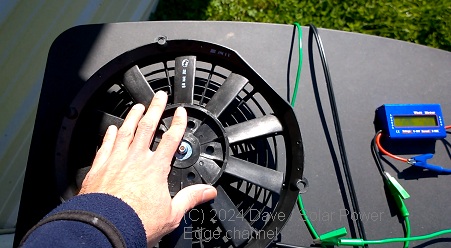
Since the solar panel wants to operate around 17v DC for optimum efficiency, the best fan would be one that allows the solar panel voltage to float up closer to that range.
Same current plus higher voltage equals more power, It also means more air moved through the fan.
The 24v fan indeed lets the solar panel voltage float higher. In fact, in the first outdoor test I conducted, I was able to get almost 50 watts out of a 50w solar panel directly attached to my 24v car radiator fan. The video for that test is linked below for reference.
Bench Test Setup
Solar panels may vary their performance significantly from minute to minute, depending on outdoor conditions. So for the bench test, I did not use a solar panel, but rather a Constant-Current Constant-Voltage (CC/CV) bench power supply. This is a valid and useful method for simulating the behavior of a solar panel.
Results
Here are the results of the bench test. The power supply was set to 18V DC at 2.5 Amps. I attached an older 12v car radiator fan (#1), a newer 12v but identical fan (#2), and an almost brand new 24v car radiator fan (#3) I borrowed from my metal shed. Also, I tried connecting 2 12v fans in series.
Comparison Table – All Fans – Identical Power Source
| 12V Car Radiator Fan #1 | 12V Car Radiator Fan #2 | 24V Car Radiator Fan #3 | 12V Fans (series connected) #4 |
| 5.72 Volts, 2.518 Amps (14 Watts) | 6.2 Volts, 2.518 Amps, (15.6 Watts) | 10.9 Volts, 2.518 Amps (27.4 Watts) | 11.8 Volts, 2.518 Amps (29.84 Watts) |
As you can see the 24v and dual 12v serial connected fans let the current limited source float upwards. This certainly agrees with the earlier outdoor test conducted with a 50 watt solar panel. The solar panel actually performed better than the bench supply, but that’s not necessarily a problem.
It’s important to use a non-variable power supply for bench testing. There was no need to try to turn up the bench power supply settings to match the 50w panel outdoor tests, as the point is to compare each fan configuration under identical, non-variable conditions. The bench power supply does approximate the behavior of a solar panel but cannot match it exactly.
I hope you found this article useful, thanks for reading and have a good day! Regards, Dave / SPE
 Solar Thoughts blog