A larger 12v lithium ion battery offers a renewable energy source for cooking. In fact, such a good sized battery can replace the fuel tank typically used for cooking in some scenarios.
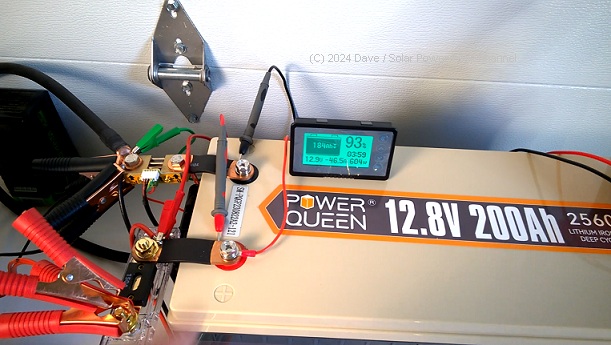
Recently I received a sample of Power Queen’s 200ah deep cycle LiFePo4 battery. I put it to the test by simultaneously operating three 12-volt cooking appliances: two of my favorite 12-volt mini ovens plus my pure 12-volt cooktop (sometimes referred to as a hotplate). Outside, four 100w 12v solar panels charged that battery up before the test. In order to properly stress test the battery, the solar panels did not charge while the cooking appliances were operating (this places a greater load on the battery itself).
No Charge Controller, No Inverter?
Although not a main emphasis of the scenario, this was also one of the first times I tested emergency off electrical grid solar power production without a solar charge controller. Believe it or not, this large 200ah battery was charged from four 100-watt solar panels outside the solar workshop – but no charge controller was used. And of course, these 12v appliances don’t need an inverter either. So this setup is cooking food using renewable solar power, while eliminating two of the most expensive and complex parts of typical off electrical grid systems. Such a topic deserves to be investigated in detail, so I intend to follow up on the research in later articles and videos.
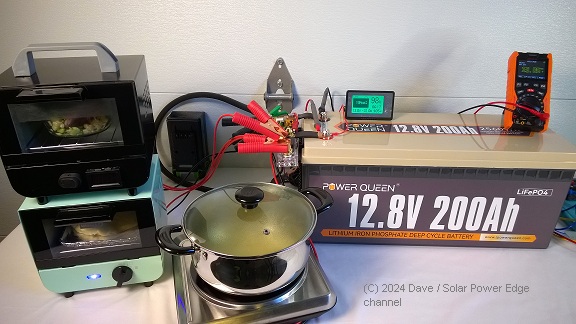
Total Cooking Time @ 12v 200ah
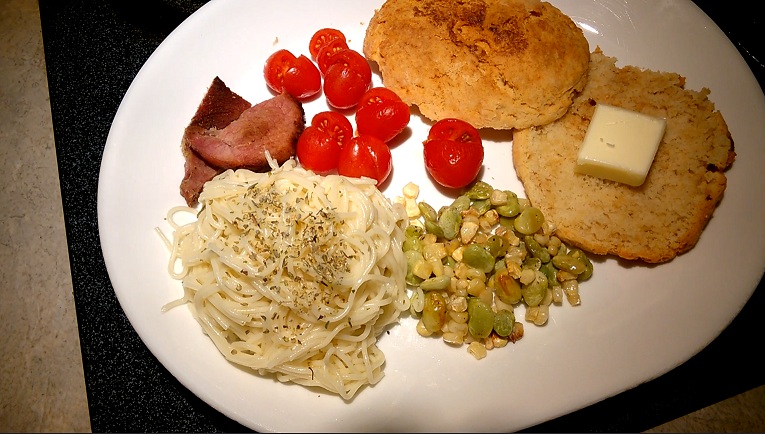
Due to their high efficiency, the total wattage consumed by the cooking appliances was about 600 watts. Since the 200ah battery stores about 2.5kW/h, in theory the appliances could run continuously about 4 hours. But it only takes 30 minutes to cook a typical small meal. This means a person could effectively cook all or most of a sunny day, with only four 100 watt solar panels supporting the system.
Advantages of Direct DC Cooking
Higher Efficiency
These cooking appliances demonstrate the power and efficiency of pure 12-volt operation. In more traditional off electrical grid cooking scenarios, solar power would first be transferred through a solar charge controller, then into a battery, then into an inverter, finally into the appliances itself.
Each time the DC electrical power is transferred or converted (for example, through a DC-AC inverter) some of that electrical power is lost and wasted. But with direct DC cooking, the electrical power goes straight through to the appliance, bypassing wasteful traditional means.
In addition, these appliances are deliberately designed for higher efficiency than their typical AC counterparts. The ovens in particular have ceramic fiber kiln insulation making them astonishingly efficient for their size. Using only 144 watts each, they can bake bread and roast meat and vegetables with ease.
Off Grid Cooking Systems At Lower Cost
With pure 12v kitchen grade cooking appliances, the overall cost of such a cooking system can be greatly reduced. Discrete electronic devices such as DC-AC Inverters are highly complex and sensitive – they have a limited MTBF (Mean Time Between Failure). Their replacement cost is quite high, and most people don’t have a chance of repairing one if it fails.
Thinking in terms of high tech survival, one might plan to use 12v solar powered systems to cook food as part of a survival and preparedness strategy. However this option is less attractive if it chains the operator to sophisticated and fragile electronic devices (like inverters) that have a limited life cycle and are difficult or impossible to replace in a challenging grid-down scenario.
Simple 12v cooking appliances do not require high voltage nor a DC-AC inverter. They have low cost and can be serviced, maintained and repaired by the end user. In my 12v oven designs, there are deliberately no sophisticated electronic circuits used. Only basic switches, relays and thermostats are required. The heating elements are Nichrome wire, cheap and easy to find everywhere – for example in broken space heaters, recycled appliances etc.
My Thoughts on the Power Queen 200ah Battery
The whole point of the test was to not only demonstrate what a 200ah 12v battery can do, but to see if the Power Queen test sample battery has what it takes to do off electrical grid cooking. It successfully passed my tests, and will be integrated long term into one of my off electrical grid solar power systems. Based on its performance in the test, I can recommend it.
Why we need robust kitchen grade 12 Volt cooking appliances
These days, most who want to cook off the electrical grid use a DC-AC inverter and plug in standard 120V AC appliances. One has to realize that all of these devices and components came from – The Grid itself. Without factories and mass production, even solar panels would not be possible. Furthermore, I believe an inverter is a rather complex piece of technology to use for such a simple purpose as getting food hot.
Therefore, if we are preparing for a potential grid-down scenario, and knowing it won’t be easy to get new inverters and access to complex technology, a different way of thinking is required. The more complex and top-heavy the cooking system is, the less attractive it is to survival and preparedness. That is why simple, robust and effective kitchen-grade 12 volt cooking appliances are so powerful. Their low-tech simplicity and robust construction lets them accomplish the same thing AC appliances do, yet without dependence on inverters or high voltage.
Unfortunately, 12v cooking appliances available on the market (as of the time of this article) aren’t really very good, and most certainly cannot be called “kitchen grade”. My prototype ovens and cooktops are in fact kitchen grade – their construction is pretty much the same as the appliances in kitchens all over the world. They are not “food warmers” but real cooking appliances built with durable construction (mostly metal) and simple components.
Summary – 12v Cooking is Better for Grid Down and High Tech Survival
These tests prove that simpler and lower-cost 12v DC cooking appliances can work just as good as their AC counterparts, while providing several attractive advantages. Including lower cost, lighter overall system weight, better mobility, higher efficiency, better survivability, and less vulnerability to failure.
Hope you enjoyed reading this article – have a good day! Dave, SPE
 Solar Thoughts blog