
An insulated solar electric cooker, sometimes referred to as “ISEC” is an insulated container that takes a direct solar panel input to cook food. These appliances are generally a DIY project and not something available off the shelf.

A good example is my small solar electric cooker which I used to boil an egg with only a 20w (14w DC) solar panel. But it was challenging to build and not available as an off the shelf item.
Wouldn’t it be great if a company was building insulated solar electric cookers, but didn’t know that they were?
That’s exactly what has happened – the appliance in questions is sold as a “thermal cooker”. A thermal cooker is a neat idea, you get a pot boiling on the stove, then place it inside an insulated container. The “retention heat” causes cooking to continue for quite a long time.
In my investigations of various cooking options, I noticed a particular thermal cooker had an interesting feature – a built in heating element. This caught my attention so I ordered one to test in my solar workshop.
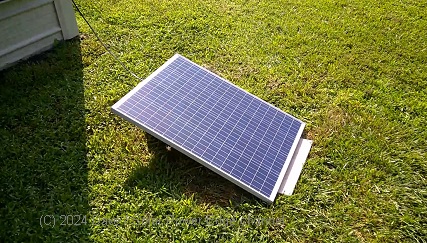
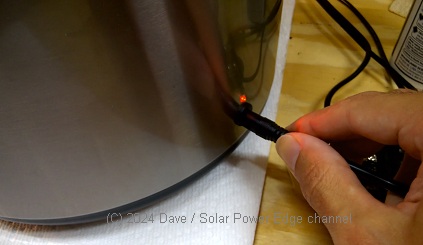
On the bench, I discovered the heating element was not particularly powerful – but it did heat. I plugged a 50 watt solar panel straight into the 2.5mm input jack. The appliance heated up, and I probably could have cooked something. But a 100 watt solar panel worked a lot better and was easier to get the heat built up.
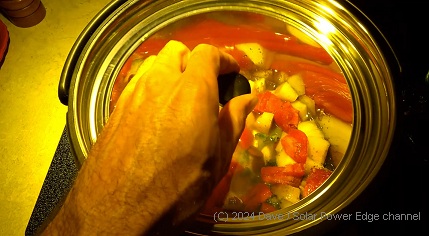
At that time I conducted numerous tests and found the performance was adequate to cook. Just to prove the point, I put actual food in the cooker, plugged in a 100w solar panel in the morning, and before noon the food was cooked. Actually, not being skilled at preparing food, I think the food was well overcooked. But edible nonetheless.
I think this appliance is a great way for beginners and DIY’ers to get their hands on a real insulated solar electric cooker for not too much cost, and with low technical requirements.
To make it work, a solar panel MC-4 to 5.5×2.1mm adapter is required. The 5.5×2.1mm plug needs to be of good quality to handle a few amps of current without getting too hot.
With the 100w solar panel I tested, it was possible to exceed 15v DC. I recommend keeping the voltage under 15v and power no more than 60w. To monitor the power input, one can use a simple and widely available inline DC wattmeter.
This appliance surprised me. It does not cost a lot of money, and is loaded with good quality stainless steel parts. I did not expect it to really cook, but in fact it works quite well. There is some concern about burning out the heating element, but with care I think it will last long enough.
The manual clearly states the built in heating element is for warming food, not cooking. How long can this appliances last when used for cooking? I don’t know, but progress does not stand still and I will keep testing and researching the idea.
If you want to try cooking with direct solar, the appliances is sold under the brand name “Austric” thermo-cooker but it could well be available under other names too.
Here is a link to purchase it if you are interested in supporting my work. This is an affiliate link which will send me a small commission if you use it to shop. Note: as of the last time I looked, this cooker was sold out. I hope there will be more options available in the future.
Another way to find it without using the link, just search online for the name “Austric” thermo cooker and I’m sure you’ll find more information..
Thanks for reading, hope to see you later! -Dave, SPE
 Solar Thoughts blog