Introduction
Hi folks, in this blog post (and associated video) I am sharing some of my first hand experience in over a decade of working with solar power and electrical systems.
A problem that a DIY solar power enthusiast may someday face is to find a solar panel [or a whole solar panel array] has good output voltage – but does not produce any power when connected to a charge controller.
Video related to this blog post: Solar Panel makes no power! But has Voltage?
Another way to describe the problem, is loading the solar panel down produces little to no power. As soon as a load is placed on the panel, the voltage drops significantly, but no power is produced.
You might notice this type of behavior in several different kinds of DC electrical power systems. Learning about it is a smart decision and make all the difference in the world when troubleshooting solar power installations.
The average person would probably start trying various things to troubleshoot such a problem.
Maybe the solar panel is damaged, or has dirt and dust on it, or has a burned out bypass diode, faulty MC-4 connectors. Maybe it is shaded and something is blocking full sun exposure.
So what’s wrong here?
The first thing that should come to mind when encountering such a condition is a single word: RESISTANCE. Understanding resistance in electrical circuits is paramount to troubleshooting these kinds of issues.
Previously, I made a video called “How to Use Ohms Law and Solar Panels to Drive DC Loads Directly“. If you have not watched that video, I highly recommend it. In that video I explained how to calculate voltage, current and resistance in a PV DC circuit.
A solar panel is supposed to deliver both VOLTAGE and current (AMPS) and produce power in that state – but our example solar panel isn’t!
So basically we loaded the solar panel down, the voltage dropped, but little to no current flows and no power was produced. What can cause this? Before continuing let’s look at another example…
First example – MPPT Charge Controller
If you have an MPPT charge controller connected to the solar panel, it might sweep the panels for MPPT (max power point) and show the solar panel voltage drop as you normally expect when the panels start supplying power – yet in this case, no current flows into the battery. So the charge controller is unable to charge the battery. Or maybe it charges very slowly….
So you load the up panel, voltage drops, but no power? What’s going on? Again, the first thing you should think about when seeing this kind of behavior in a DC electrical system is RESISTANCE.
Ohms Law (Formula) states that the resistance, voltage and current in a normal electrical circuit are all interrelated mathematically and can be calculated. If you want to learn more about Ohms (Formula) then please check out the videos linked in this article.
Anyway, if the problem is resistance, then WHERE is the resistance?
So what can actually cause this behavior is ADDITIONAL resistance which has been added into the DC circuit, and is aggressively LIMITING the CURRENT FLOW.
When the charge controller tries to draw power in the form of VOLTAGE and CURRENT (AMPS) the voltage drops as you expect on a loaded panel, but no current flows, because of the HIGH RESISTANCE somewhere in the circuit.
Because of the unwanted resistance in the circuit, you can’t actually draw enough current from the panel to drop it’s real voltage, because the resistor is dropping that voltage before it gets to your charge controller, thereby preventing you from getting any current or power.
To the average solar power enthusiast, this behavior in a solar power system might seem like a mystery. But the folks who studied up on Ohms Law/Formula already know exactly what’s happening, often with very little investigation required. The culprit is very likely to be additional UNWANTED RESISTANCE somewhere in the circuit.
In simpler terms, there is probably a bad connection in the circuit, or something impeding the current flow. It could be a broken crystalline cell, a burned circuit breaker, a loose connection, a melted MC-4 connector, a broken wire, or a faulty solar panel if there are multiple panels connected in series.
A practical example
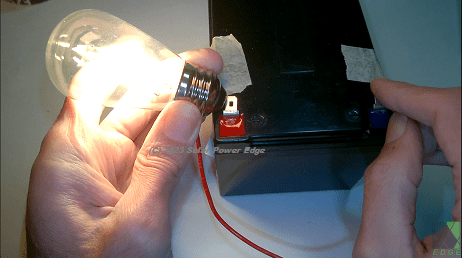
To help make this easier to understand, let’s try another example. Imagine you have a simple 12V battery and a light bulb. You connect the light bulb to the 12V battery, and it lights up.
Now imagine adding a very high value resistor in series (circuit) with the light bulb.
Do you think the light bulb will light up?
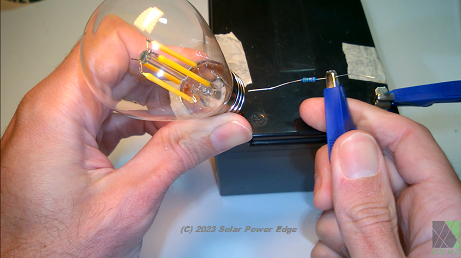
The answer is, no, it will not. That is because the high resistance is not allowing enough current or any current to flow into the LED light bulb, and so it does not light up. The resistor blocks or impedes current flow. In order to light the bulb, there must be the presence of not only VOLTAGE but also the availability and flow of CURRENT or amps. You need CURRENT (AMPS) plus VOLTAGE (pressure as I like to think of it) to supply power (WATTS) to light the bulb.
The high value resistor won’t allow any current (or amps) to flow, so, no light. Current can be throught of as the QUANTITY or FLOW through the wire, whereas VOLTAGE is potential pressure that might be available to run your load.
Although it is not necessarily technically correct, I like to think of electricty as water in a water hose. Water Pressure = voltage, pinch the hose that is resistance, and the gallons per minute flowing = current.
If you were to turn off the light bulb and take your multimeter and measure the voltage of the battery but through the resistor, it will of course give you a voltage reading. But that does NOT guarantee any CURRENT can flow, as the resistance of the circuit will determine that. The multimeter doesn’t really draw significant current, so it’s able to take a voltage reading.
Effects of resistance on a solar power system
In a normal solar power system, you would want to have minimal resistance in the connections and wires feeding the whole circuit. When you have a bad connection, it could manifest as follows: wires and connections heating up, low power output, or even NO power output at all.
So the first thing I’d check on a solar panel that drops its voltage but does not output any power (current) is obviously the MC-4 connectors. I mentioned this in my video “10 things to learn about solar” (shown on this page). But, that isn’t the only potential source of the problem. Unfortunately, there can sometimes be problems in the solar panel’s Junction Box and even the bus bars and connections encapsulated in the solar panel itself.
I have personally experienced this problem several times, in particular on a brand new 100 watt flexible solar panel. I figured out what the problem was, it was of course exactly what this video is about. There was a really bad connection with extremely high resistance in the junction box. When I would place a multimeter across the terminals of the solar panel, the voltage was good. But as soon as I placed any load on the panels, the voltage dropped to nothing and – no power.
On the surface, this is perplexing behavior, but understanding Ohms Law Formula will ensure you can troubleshoot and tackle these kinds of issues with relative ease.
I hope this article helps you out. Thanks for reading, take care – DD, SPE
Related Videos, including the one addressing Ohms Law Formula:
In this video about PV solar heat, I talk about the relationship between current, voltage and resistance:
10 things to learn about solar – This is one of my earlier videos that’s good for new solar DIY’ers and beginners!
 Solar Thoughts blog