Hi folks, most survivalists know how much food & water they need to survive “X days” in the jungle”. That’s because they are smart and take time to think things through!
But have you ever wondered, how many slices of toast can that 12-volt 10 amp-hour lithium battery make??
Note: this article is about an ongoing research project of mine relating to solar power and high-tech survival thinking. I will also be posting several videos documenting my work in this area. Please check them out if interested. Your views / likes help support my work and bring it to the world and those who need it. Thanks!
In this blog post I will address an often overlooked aspect to solar power: how much power does it actually take to do a particular task?
Right now batteries and solar power are relatively easy to get. But that may not always be the case. Part of my philosophy is “high tech survival”: learning to use technology to survive, yet not becoming bound and trapped by it. Plus increasing efficiency so fewer batteries and watt-hours are required to do the same work. So, know what your technology (such as batteries) can do extremely well – but avoid using technology when a few sticks and a match could do a better / faster / easier job.
What is a Watt-Hour?
A watt-hour is a measurement of electrical work or Power Over Time. If you have a 12-volt battery running a light bulb at 1 Amp (current), that’s 12 Watts (Power). If you run that bulb for 1 hour, it will have consumed 12-Watt-Hours.
A typical 50ah LiFePo4 battery would have about 600 Watt-Hours of capacity. So if you only had 600 watt-hours to work with, what could you actually do with it? Many people have absolutely zero clue – and could not answer the question! My goal is to look into these topics and learn how much a “watt” can actually accomplish.
1. How Much Power To: Cut A Piece of Metal??
Many DIY’ers and survivalists cannot answer this question and have no idea! But I had to know the answer. What if batteries were scarce, and you had to be very careful with them? You’d want to know how much “work” could get done with your limited power storage and resources. This is preparing for survival – thinking ahead.
In the case of cutting metal, the topic is very difficult to research. There are so many tools and methods. Why not use a hacksaw? Well that would be plan B and the cut would probably not be very straight….
To answer the question, I used my Harbor Freight mini cutoff saw with an abrasive blade. This saw can consume quite a lot of power in some cases. But it’s small and makes a nice straight cut – unlike other methods such as a reciprocating saw…
What I did was rig up a wattmeter with my inverter and a tiny 50ah 12v battery. Then I could track the watts consumed while cutting the metal. A small piece of aluminum took about 2 minutes to cut. How much power did it really consume from the battery though? I was shocked to discover how little – and came to some important conclusions after the test. If you’re truly curious, watch the video below!
2. How Much Power To: Boil One Egg?
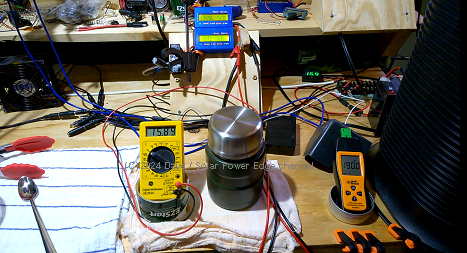
This high tech survival thinking led to a variety of research projects such as my mini solar-electric diode-based (semiconductor) cooker that consumes 14 watts of power and boils an egg with only about 20-30 watt-hours. Yes, that’s all it takes! However this appliance was designed to be hyper-efficient, far out of ordinary. Therefore it was quite expensive to construct….
Possibility has an Open Mind! Some lazy “internet people” accused me of faking this mini solar cooker – but talkers always try to discourage doers! That’s the way of the world these days.
3. How Much Power To: Bake a Piece of Bread??
Part of survival is keeping up the caloric intake. Bread can of course help with that and also be cooked a variety of ways including over an open fire. But I do believe small portable 12 volt ovens and cooking appliances should be cheap (<20$) and widely available as the common mans alternative. They allow cooking with zero smoke signature and have quick and convenient operation. Stopping in the field to build and maintain a cooking fire can be a huge impediment to survival and staying mobile.
So how many watt-hours did one of my tiny 12 volt DIY ovens take to cook a piece of bread? Well you’ll have to watch the video below to find out!!
Folks thanks for reading this article and I hope to see you next time! -Dave, SPE
 Solar Thoughts blog