Have you ever looked at an extension cord and wondered “how much power is it wasting”?
And how about those cheap skinny solar MC-4 cables – maybe they’re not such a bargain either. Or perhaps you never gave any of this a single thought!
It is a fact that using the wrong cable or cord can waste a significant amount of power. Not only that, using a cord that is too long with too much resistance can damage appliances or even burn out a compressor motor.
If you prefer a video format, this article has an accompanying YouTube video, posted below.
All Cables Have Resistance
Resistance is very simple to understand. Take a common extension cord for example – it usually has 2 or 3 copper wires inside. To use a common model or way of thinking, the electrons flow relatively easily as electricity along those wires to power your appliance. However, there is no free lunch – it takes some “effort” or “work” for those electrons to travel from one end to the other. The result? Some of their energy is lost!
Where does that lost effort go? The answer is, it turns into heat. The extension cord in this case is literally acting as a long and skinny electric heater. If the cord loses 50 watts for example, that means it is warmed up slightly by – 50 watts. Easy!
Warning: some cheap extension cords have what’s called “copper-clad aluminum” wire. This is aluminum wire (instead of copper) with a thin coating of copper plated on the top. It looks like copper wire, but is not. Aluminum is cheaper but has a lot of resistance – but it has too many drawbacks to use for extension cords. Therefore, I recommend you avoid it at all costs! Make sure extension cords have pure copper wire before buying. Just my advice 🙂
Is A Thicker Cord Better?
The short answer is almost always YES. Because thicker conductors in a cord mean less “resistance” and so it’s easier for the electrons to travel. If it’s easier, then less power is lost. In fact if it’s an AC extension cord, the appliance will probably perform even better.
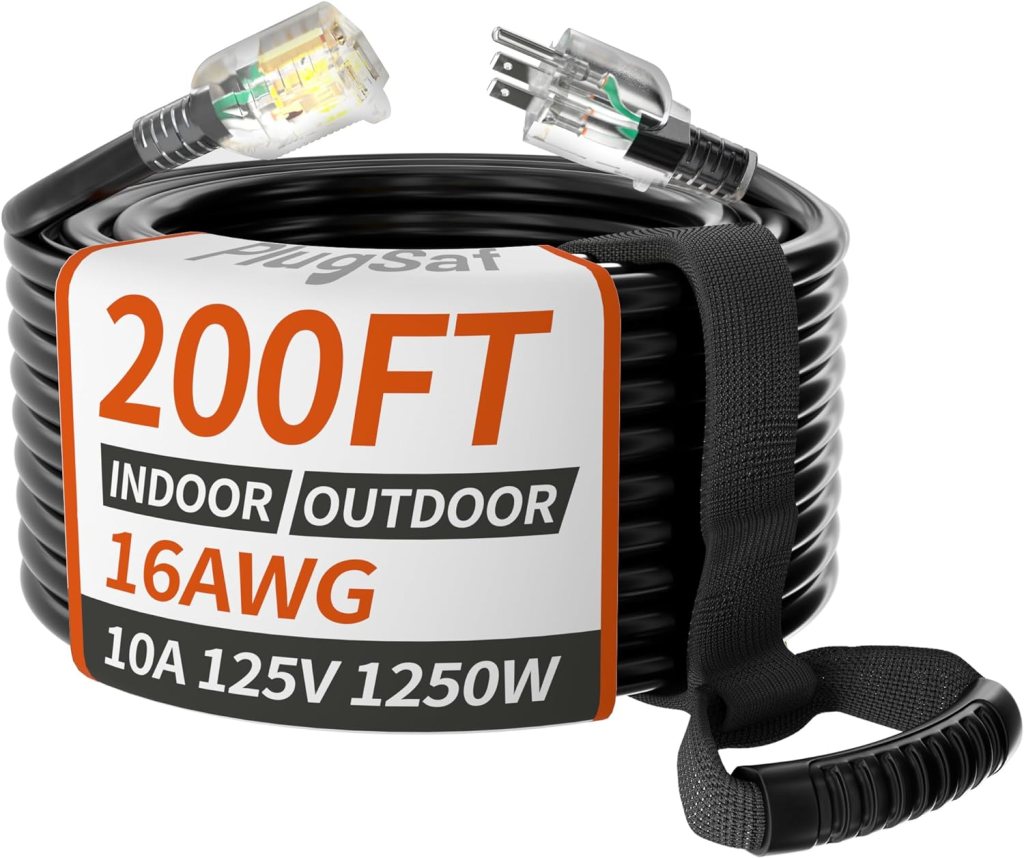
Cable and wire are usually measured with a wire gauge standard. For example, American Wire Gauge (AWG) is very common. The smaller the gauge number, the thicker the cord and conductors should be.
For example, a 20 AWG cord is very skinny, but a 10 AWG cord is relatively thick (and also heavy, which is a major downside).
When Voltage Drops
What is the number one way to easily detect excessive resistance in a cable or cord? The answer is Voltage Drop. Let’s say you have 12 Volts available from a battery. You connect 2 wires to a 12v appliance to the battery, and turn it on. The appliance runs, but the wires get very warm. What does that mean? It means those wires are dropping voltage and wasting power.
If you measure the voltage at the battery, and again at the appliance itself, the voltage at the appliance WILL ALWAYS measure lower than at the source (the battery). That’s because some of that voltage was dropped by the excessively skinny wires connecting the appliance.
The simple fix for this – upgrade the wires. Yes that costs money, copper isn’t cheap. Thicker cables have less resistance and better electrical flow, so they drop less voltage, which means more of that voltage reaches the appliance. Also, it means the cord is more efficient because it doesn’t drop as much voltage, doesn’t get as warm and delivers more power to the appliance.
A Warning About Inductive Loads
Let’s focus specifically on a common task: running an air compressor, shop vac, refrigerator, air conditioner or freezer on a long extension cord. Things start to get a little more complicated – because these types of loads are called inductive loads.

In short, this means the appliance is powered by a motor that uses Alternating Current (AC) and AC voltage to turn a motor based on the principles of electromagnetic induction.
Put more simply, these induction motors work differently than say, a simple space heater (resistive load). Induction motors can be very hard to start in the first half-second or so after they are switched on. They may demand an enormous amount of power (a surge of power) for a brief moment. For example, an air conditioner rated at 500 watts might demand 3000 watts or more for just a brief moment. After about a half second to one second, these types of motors start to spin up and the power demand is vastly reduced – to whatever is normal (it’s printed on the side of the appliance).
The problem is, when that induction motor first starts, it acts very much like a short circuit – not a motor. And during this brief moment, due to the massive power draw, the voltage drop on the power cord greatly increases. So maybe that cord drops 7 volts at 500 watts – but when you first turn on the inductive load, it demands 3000 watts – it might drop 25 volts or even more!
And that leads to the next problem: if the voltage drops too low (let’s say 120v drops to 95v for a brief second) that is possibly not enough voltage to get the motor turning! The result? Effectively a short circuit. What will the motor do? It will not turn: but it WILL get HOT! And then… it burns out!
Avoiding Appliance Failure Due To Insufficient AC Cord Size
How to avoid burning out the AC induction motor in your appliance? First of all, if you’re running an inductive load such as an air conditioner or freezer, pay attention to the length and gauge of the cord. If the cord is 25 feet long, you can get away with a lot more. A shorter cord has less resistance than a longer one for the same wire gauge.
If the cord is say 150-250 feet long, that’s very unusual – special attention is required. First you should test the cord for voltage drop using a simple method. I explained how to do that in the YouTube video posted on this page.
There are a couple of easy ways to test the cord – one is to use common AC watt meters that plug into the outlet and display voltage, amperage and wattage. Simply use this meter to measure both ends of the cord while the appliance is running. Then write down the results.
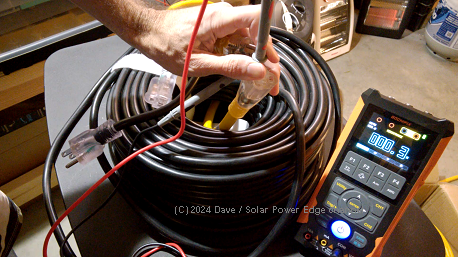
The second way is to borrow my rule of thumb: don’t run AC inductive appliances over a cord that has more than about 0.5 Ohms of resistance. Simply take a multimeter on ohms range, and measure both sides (live and neutral) of the cord. Add them together. If the cord has about 0.5 ohms, you should be able to run a freezer, fridge or air conditioner pretty easily without risk of burning out the compressor or motor.
If the cord is around 1.5 ohms, I think that’s too high and too risky. Use a thicker or shorter cord! It’s not worth risking the appliance!
In my case, I had previously “cheaped out” and bought a supposed 12awg 200 foot extension cord. It worked for light duty. But when I tried to run a few hundred watts through it, the voltage dropped too much. So I ended up also buying a 10awg 200ft cord from another company, which cost more than 3x as much. However, the difference between the two cords was night and day. I will still use both cords, so thankfully the cheaper one was not wasted.
I hope this article was helpful and useful to you. It is intended to educate the public about the cables and cords all around them, and the importance of understanding how they work. Perhaps now you will never take that old extension cord out in your garage for granted again! At the very least, if the cord gets really hot you will know why 🙂
Thanks for reading! -Dave, SPE
PS if you wish to support my work, here are affiliate links to the extension cords shown in the video and used while writing this article.
Full Disclosure: I receive a small commission if you use these links to shop. Thank you 🙂
Simple AC Watt Meter for measuring extension cord performance – they’re cheap and work good. My all time favorite! https://amzn.to/3PfMs2g
The yellow 10awg 200ft extension cord as shown in the video – had much better performance even up to 800 watts than a cheaper one: https://amzn.to/4gQfSjn
Smaller 12awg 200ft cord shown in video – OK for running up to 300 watts over 200 feet: https://amzn.to/3P92xXR
 Solar Thoughts blog