Solar panels do so many things very well, but there is always room for improvement and new ideas. One application I find interesting is to directly drive a Hot Water Heater (HWH) heating element in a water tank with PV DC solar panels. But are there better ways to do it?
I made a video about this topic, as well, posted below!
Heating Water With PV DC Solar Panels vs. Solar Thermal
Direct Drive PV DC water heating makes a lot of sense: no fragile glass tubes, no pumps and pipes, just standard residential HWH technology blended with high-tech but simple PV solar panels and a couple of thin wires to supply heat. You end up with not only hot water for utility purposes, but also a potential thermal heat storage system.
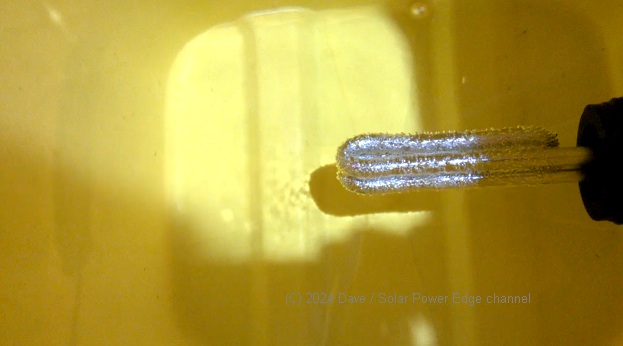
The heating elements found in most residential HWH tanks are made of nichrome (Resistance) wire and are placed directly in the water (this is called immersion). An immersion heating element is the best way to get the heat directly into the water. Water itself has fantastic capability to accept and store heat, unlike sand or other substances.
Heating water with solar panels can make a lot of sense for some people. But there are downsides to such a simple and robust solar water heating system. Technically speaking, a resistance heating element can never match the dynamic behavior of solar panels under changing conditions. This means the Voltage, Current (Amps) and Power (Watts) are always fluctuating but the heating element stays very linear – effectively the same all the time. In short, it cannot hold the solar panels at the ideal voltage all the time, so power (and heat) are wasted.
And that is why MPPT (Maximum Power Point Tracking) technology is so popular. It isolates the load (usually a set of batteries being charged) from the solar panel array, while tracking the most efficient voltage needed by the solar panels to make their best power.
Resistance Heating Elements vs. Semiconductor
But a resistance heating element doesn’t work this way: it has a basically linear response to the voltage and current of the solar panel array. If the solar panel can make more power suddenly, the resistance heating element just follows the curve, and the voltage across it increases. This means more power, but it cannot hold the most efficient array voltage, as it’s just a resistor. So a lot of power (and heat) are just wasted. MPPT circuitry solves this problem. But MPPT is a complex set of electronics and not simple to understand, troubleshoot let alone repair.
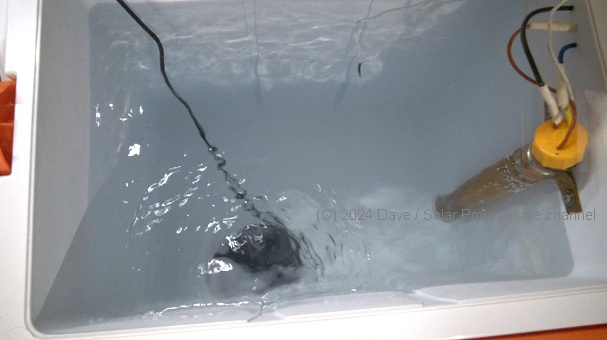
However, a semiconductor immersion heating element made of a diode chain (diode string) does not behave this way. It does not need MPPT, because diodes have a exponential / logarithmic behavior when exposed to the IV curve of the solar panel array. Although it’s not perfect (like an intelligent electronic MPPT circuit) it does have the ability to regulate the voltage of the solar panel array, and thus extract more heat than the resistance heating element.
Increasing Efficiency, not Complexity and Cost
Plus under changing conditions, semiconductor heating elements react to increased or decreased current supply, thus maintaining a more efficient array voltage. All of this is done with virtually no electronics. Well technically a few diodes in series is considered “electronics” – but it sure isn’t complicated or expensive.
I have spent hundreds of hours researching the fascinating behavior of diodes. The simple yet effective idea of a series set of diodes acting as a heating element creates the opportunity to extract more heat from the solar panel array vs, resistance heating elements, yet still avoid the complexity and cost of MPPT circuits.
This idea has been explored by quite a few researchers all over the world, but I do not know if or when it might become a more common sight. I have been able to cook food, boil water and even heat my workshop with power diode chains. When used properly, the technology works, and it works well. Plus, it’s dirt simple and dirt cheap.
The Challenges of Building Prototypes
Heating water is challenging though, as I could not find any commercially available diode packages that were suitable for immersion water heating. That is what drove me to build several handmade prototypes. One of them is explained in the YouTube video posted on this page.
What else can simple power diodes do? My research into this idea will continue, and I hope to post further updates in the future. Hope you enjoyed this article, thanks for reading! Take care! -Dave
More videos about Diode Chains…
 Solar Thoughts blog