I made a video about this project – blog article continues below:
Stopping A Well House From Freezing
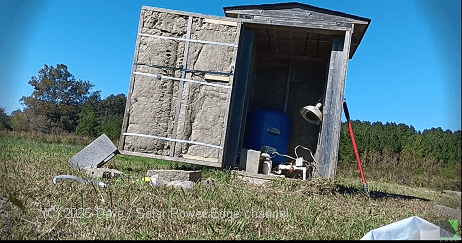
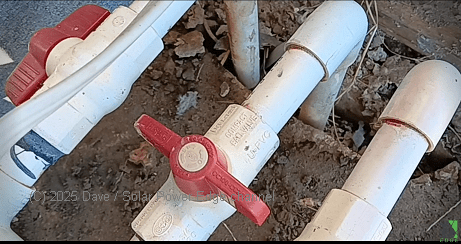
When I moved to a homestead farm in the country, one of the things I dreaded was the well house freezing. A well house is a tiny wooden “house” built over the top of the well head, valves, pressure tank and any other related equipment to protect them from the environment. In the winter time, a common problem is the pipes and connections inside will freeze, causing an expensive repair bill.
I knew many people used a ~250w 120V AC Infared heat lamp bulb to warm up the pipes. In fact, the well house I bought had such a bulb installed already. Problem is, it uses a lot of electricity. If you figure running it 24 hours a day, that’s about 180 kW/h of electrical power, something like 30 bucks worth of electricity for one winter month. Not so great…
Why not use solar power instead? That was my plan. First, I insulated the well house with Rock Wool R-15. It’s expensive. Good stuff, not fun to work with but it gets the job done. After installing the insulation, the well house was certainly warmer already.
I added a wireless thermometer to monitor the interior temperatures remotely.
Time For Solar
Next I placed an approximately 250-300 watt solar panel outside with 2 PV cables running inside. I did not have the time and luxury to do a neat job. I just needed to get it done. So I didn’t even use a circuit breaker or shutoff.
In the first experiment, I used a simple Quartz heating tube roughly matched to the solar panel. I managed to get anywhere from 150 to 250 Watts of heat (500-850btu/H) out of that tube depending on the amount of sun. It’s a start – not too bad!
Thermal Energy Storage Solutions
I initially placed the quartz tube on a simple cinder block that was available. It didn’t seem like a great solution – but in fact it worked extremely well. The cinder block soaked up quite a lot of heat. Using a thermal IR camera, it was possible to see the heat traveling down the block from the quartz tube. So simple, but it works so well. In fact, it got up to 79 degrees (Fahrenheit) inside the well house when the weather was mild. Not bad! But not necessarily a real test.
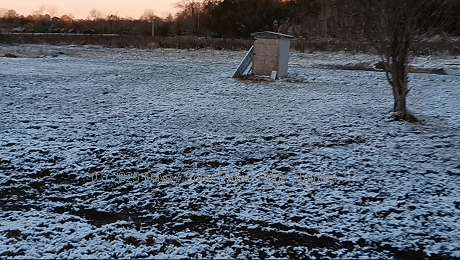
That came later – the temps dropped just into freezing for the first time early in winter, and we had snow during the night. In the morning, the temps were still 32F but the well house was in the mid 40s after having no power all night!
So I was definitely heading in the right direction. My goal is to prevent freezing down to 10F, but we’ll have to wait for colder winter temperatures to really make sure one solar panel is adequate.
Sand Batteries
Next, I tried making another sand battery. It’s not my first time working with sand and Thermal Energy Storage (TES). I am not a huge fan of sand batteries, because they have many drawbacks and problems including the requirement to operate at very high temperatures. But I keep an open mind – and I know sand based TES solutions can be viable in some cases.
While doing research for the project, I had been studying a scientific research paper about enhancing sand batteries. One method is to add metal scrap to the sand. I thought why not give it a try – and bought a cheap metal cooking pan and added some fine sand mixed with metal shavings. For this project I avoided coarse sand, due to my previous tests and experience.
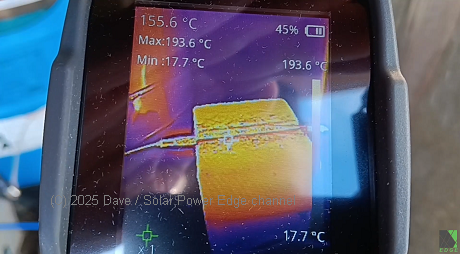
I then placed the quartz tube on top of, but not in the sand, and then placed the lid on top. This setup concentrated enough heat to charge the sand with heat while simultaneously testing the effectiveness of the metal scrap mixed in. This method also allowed a good amount of infrared heat out to immediately raise and maintain a good temperature in the well house.
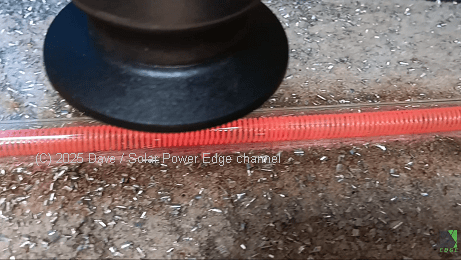
This solution worked pretty well. It’s a little more complicated and expensive than a simple cement block. Using a thermal IR camera, I was able to see the heat traveling into the sand and through the metal scrap.
OK, I think enhancing sand batteries with metal is a great idea, and I plan to try it on a larger scale as soon as humanly possible!
The Bottom Line
This experiment was very successful – it works. But I need a very cold winter night to confirm whether I should add more solar power and/or TES. I hope just one solar panel would be enough, but it’s hard to know for sure.
I do plan to increase the thermal energy storage capacity as I don’t think it’s enough. A well house doesn’t need to be super warm inside: just staying above the freezing point is adequate. My guess is adding bit more thermal storage for overnight heating will do the job.
If you like this kind of stuff, check out my YouTube channel which has over 180 videos and lots of other projects too!
Thanks for reading, have a great day! -Dave, SPE
 Solar Thoughts blog