The Reality of Solar is a term I started using years ago in some of my earliest videos on YouTube. As a scientist at heart, I’ve always been curious about the true nature of reality. I don’t care for armchair expertise (not to mention the opinions of armchair experts). No I want true real-world hands-on experience for myself. It takes so much effort to gain real-world knowledge and experience…. but that’s the way it is. DIY = Do It YOURSELF!
Reality is the best teacher. I hate referencing tables of numbers, charts and theoretical calculations, as those can’t prove reality. They’re just models and theories. Instead, I prefer to gather data and experience myself, using realistic scenarios and in real time.
*Related Video – Blog Post Article Continues Below*
There is so much to the reality of solar, but I like to start with this thought:
Everything Came From THE GRID
Batteries come from the grid. Solar panels come from the grid. Charge controllers, cables, fuses, logistics, mining, communications, shipping, factory production, the list goes on. We all use the grid every single day, and for the vast majority, there is no way to disconnect from the grid. I find it strange to use the term “off grid” or going off grid. But, how else to communicate! Those terms are legendary and universally understood by many, this is another reality of solar. That’s why I sometimes refer to it as “Off The Electrical Grid” but I’m not sure the distinction is worth the effort…
2025: Learning About The Reality of Solar – But With What?
After months of being distracted and overwhelmed with our recent move to a new homestead from January to August of 2025, I never had a chance to accomplish any real solar-related goals that year. Nor could I deploy a decent solar farm like I’ve always dreamed of, or truly convert my home to 55V DC power as planned for many years. Too much work for one tired and overwhelmed guy.

Instead, it was back to the same old tried and true tactics… cinder blocks, bricks, and scrap lumber with solar panels laying flat on top. PV cables running all over the place… and of course, the wind kept showing up to ruin the party… repeatedly flipping my panels and pulling out the cables…
But it’s for science… I don’t let anything stop me. How many places in the world do folks have no choice but to plop a solar panel on their roof or out on the ground? They cannot afford special premium mounting solutions, stainless steel hardware, concrete and other materials. They don’t have a lot of money, and can’t afford perfection… to use a popular term, The Struggle Is Real!
Re-Using Solar Equipment That Moved With Me
At my last house, over several years I had slowly and painstakingly built up a good sized off grid solar power system. I never showed it on YouTube because I felt it was boring, and not very relevant to the content I wanted to create. We had gathered over 25kWh of LiFePO4 storage (not counting reserves) multiple inverters, a quality charge controller, and plenty more equipment. I also had a small 55V PV-DC micro grid.
But the truth is, the whole system was never what I wanted it to be. I never finished it. It remained a makeshift setup with equipment mounted to several boards and solar panels laying in the yard on bricks and scrap lumber. Could it run freezers? Air conditioners? Provide 55v DC heating and cooking? Sure, no problem at all.
And then I had to sell my house, tear it all down and leave. Thankfully, in the chaos of moving throughout 2025, all this solar equipment was able to be salvaged and taken with me. Time to start over…
What I Learned From “Makeshift Solar Setups”
By September and November of 2025, I had started doing some small scale solar work at the new homestead. I found myself laying out more and more solar panels on boards and bricks. Whenever time and health were permitting, I’d go out to my “solar stash” and drag out another solar panel to increase my solar capacity. Despite such austere measures, this setup was making me power every single day. Solar is such amazing and simple technology. Part of what I learned is that solar doesn’t have to be “pretty” – just as long as it works.
I managed to restore and continue testing my 55V DC Micro Grid experiment and even continued expanding it, trying out new ideas. The 55v system, being several years old, has remained so simple in its design. It heats my room in winter, boils water for coffee, operates ovens and cooktops to cook food with zero gas burned, and more. Yet is has no charge controller, inverter or complex expensive electronics. I never get over such simple and effective technology – it amazes me every day. This taught me that solar doesn’t have to be as complicated or as expensive as generally assumed. Direct-PV DC systems have great promise, potentially bringing solar technology to a broader segment of people all over the world.
Does our “solar cinder block farm” look humble and makeshift? Sure. It won’t impress anyone on social media, but I don’t care!
What 2 Off Grid Freezers Taught Me About Reality
Fast forward to right around November-December of 2025. I got hideously sick, catching the flu for the first time in over 20 years, plus having a violent migraine and vomiting episode at the same time. Just great. Same old problems, plus new ones…. but during that time, I had an idea and curiosity took over. There was no way I’d ever get my new homestead “off the electrical grid” in any significant way in 2025. It wasn’t going to happen. But what if I started with just ONE freezer? Or TWO? And see what it takes to run those? How much equipment, how much wire, how many solar panels… and that’s what led me to create an isolated experiment. I call it getting off the grid – one day at a time.
Disclosure: I often place Amazon affiliate links on my channel and blog. If you use them to shop, I might receive a small commission. It helps. Thank you for your support 🙂
Another Solar Experiment
I started by gathering up necessary components and equipment, 90% of which I already had:
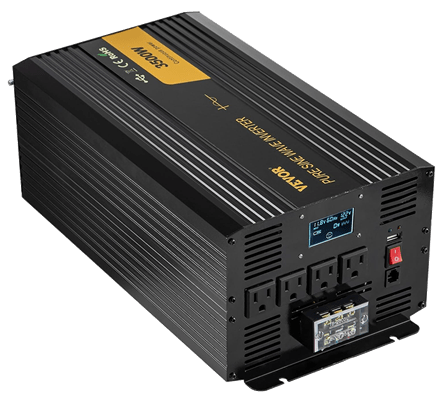
- 12v 3500w Vevor Sine Inverter. I extensively tested this inverter on video, it passed my tests and earned my respect
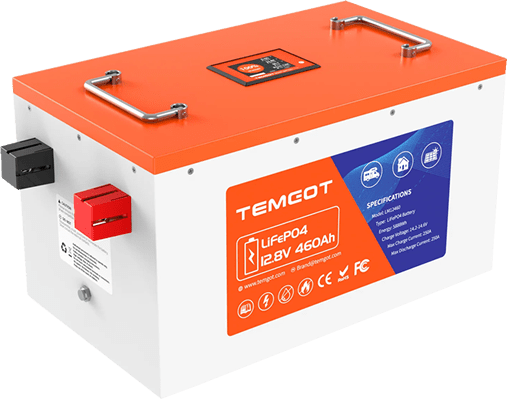
- A 460ah Temgo LiFePO4 Battery (provided by Temgo for evaluation and testing)
- A simple MakeSkyBlue MPPT charge controller
- Assorted wiring and cabling
- A combination of 200-Watt solar panels: starting with 2, later 3, and then 4
- I invested about $80 for upgraded cables for my inverter, plus $7 for an ANL DC fuse – I don’t trust a “BMS” to protect me.
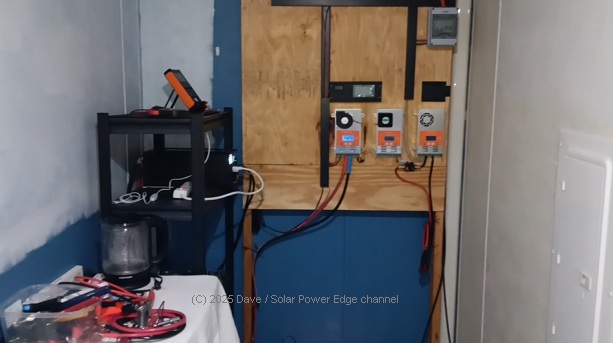
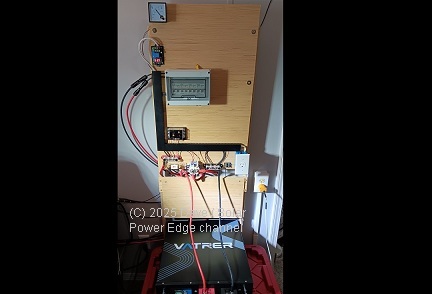
To start my small-scale off grid solar project, I unpacked a solar power equipment board from the Solar Workshop I lost (had to sell it with my last house – still sad about that!).
The good thing is this board already had a voltmeter, 3 cheap MakeSkyBlue charge controllers and a circuit breaker box. Using what I already had made this project possible. My goal was to get something off the electrical grid BEFORE 2026 could arrive…
The Temgo battery has an integrated battery meter, also known as a coulomb-counting amp meter with a screen mounted on top of the case. It shows battery percentage, amps in/out and cell balance information. This makes it a very convenient plug-and-play battery for a variety of purposes.
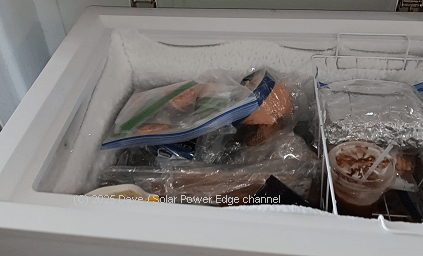
I then hooked up the charge controller to the 460ah Temgo battery, connected the inverter and ran PV cables into the house to connect the solar panels. With other distractions and work going on, the whole process took a few weeks. Not to mention getting extremely sick. But I got it done and moved 2 of my 3 freezers over the inverter. It was a good feeling. Some off grid is better than no off grid.
What I soon (re)discovered is that it’s incredible how much expensive equipment it takes to run just 2 freezers on solar. The system worked, but it struggled to keep the battery full. With dull and sometimes non-existent winter sun, 2 solar panels made it totally impossible. 3 solar panels made it a little easier, 4 seemed like the bare minimum. Worse still, the solar panels don’t have proper racks, and thus could not be angled properly due to wind. I had to lay them nearly flat. That really affected winter power production.
Even with 800w of solar panels, I ran that 460ah battery flat dead one night. We were awakened at 3 AM by the inverter beeping like crazy and I had to shut it all down. However after a few days of sunny weather, I was able to get the battery state of charge above 50% and then things were better. This experience taught me a lot. It is a good feeling knowing your freezers don’t need electrical grid power any more.
In solar, battery power storage is key. We need power storage to get through the night plus cloudy and dark weather. But, unfortunately, batteries are expensive…. this is why I am so interested in PV2L / Direct PV-DC appliances and micro grid technology – less battery cycling. Leaning harder on simple PV panels during the day to get the heavy lifting done means less reliance on battery cycling.
A Lesson in Economies of Scale
Why does it take so much equipment just to run a couple of freezers? To say nothing about running an entire house. With the typical lithium battery, charge controller and inverter setup, it is not possible to reach a cost-per-Kilo-Watt-Hour matching the power company right at the start, and probably not at any time. The reason is, solar power equipment is extremely expensive and requires significant investments up front. The power company has what is called “Economies of Scale”. This means bigger systems can produce electrical power much more cheaply than small systems.
Even if a cheap charge controller “pays for itself”, it will eventually fail, requiring re-investment. Thus, the system can never truly pay for itself. What this teaches me is that solar shouldn’t be about “beating the power company”. Instead it should be about peace of mind, freedom and independence. Having the ability to produce your own electrical power is truly worth its weight in gold. The true worth of a solar power system is not how many Kilo-Watt-Hours of power are produced, but the freedom of producing ones own electrical power, anywhere, anytime, and on your own terms.
Every Household Should Have Solar Panels
I believe all households should have some backup solar power capability and a few solar panels, even if they don’t care about solar at all. Even a small solar setup can help a family survive extended multi-month power outages and disaster scenarios.
During a power outage, a bit of hot food, some decent lighting at night, a charged up phone, maybe some internet or computer time can go a long way. These benefits can boost morale and help a family through tough times, and maybe even keep them happy while they’re doing it!
I hope you enjoyed this article.. Thanks for reading and stay tuned! -Dave, SPE
 Solar Thoughts blog