I decided to build an off electrical grid “Solar Gas Station” for my riding electric mowers.
Gasoline is not a bad thing: it’s universal, energy-dense – easy to use – reliable – consistent and it works. There is so much energy in a gallon of gas that a battery can’t hold a candle to it.
Yet it is a dependency I’d like to eliminate, or reduce. Ever get a 500 dollar electric bill? Yeah. So I’m striving to build an all-electric DC homestead. It’s not something that can happen overnight.
Acres of Grass – How To Mow With Solar?
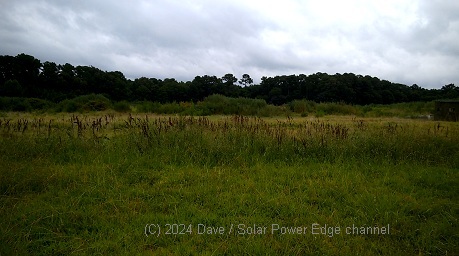
Recently, I moved to a new property with a huge amount of grass – several acres. Honestly, looking at all that grass made me tired, but I loved the healthy peace and quiet the property brought to the table.
As preparation to “survive” this challenge, I found and bought a cheap and affordable but not-so-working Ryobi 48v electric mower. This quickly expanded our electric riding mower fleet to two: my original Ryobi ZT480e zero-turn and now also an RM480e riding mower. I knew one would never be enough with all that grass.
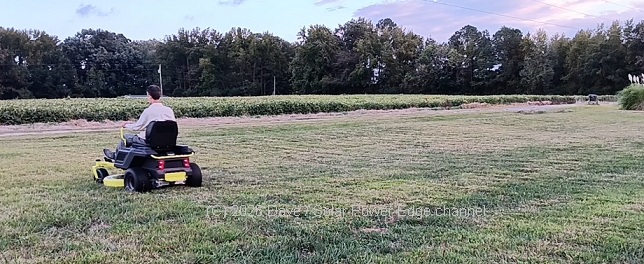
I bought the ZT480e itself brand new (extremely reluctantly) several years ago when I badly injured both shoulders. Couldn’t bend over or do oil changes, or even pull the start cord on my gas push mower. Couldn’t sleep for a whole year. Couldn’t do anything! So thank God for my Ryobi electric mower – it was easy to use and I wouldn’t have survived without it.
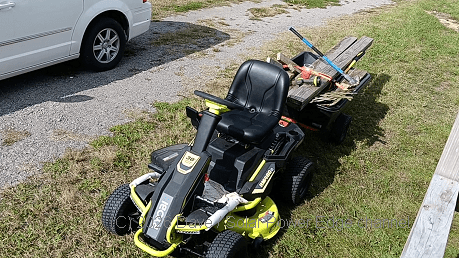
Since buying it in late 2025, I’ve had continuous issues with the RM480e. Pretty sure it was a malfunctioning return or old stock, and it certainly was not working well. In fact, I couldn’t even steer or keep the mower powered on when I first got it. Yet it was a must have. I still need to finish repairing it – someday… too busy with everything else.
So both mowers are 48v battery powered units converted to LiFePO4 51.2v. However, they consume kilo-watts of electricity per mowing session, and charging from the grid? That’s just running up the electric bill. No thanks!
A Solar Gas Station is Born
My goal from the beginning was to mow all the grass on the property with solar power. Getting both riding mowers off the electrical grid was high priority. Ever since receiving a record breaking power bill, the urgency level was crazy high.
I wanted to build a dedicated “solar gas station” for my riding mowers, push mowers and 18v/40v lithium weed wackers. But Solar is real expensive. Each mower has about 4kw of capacity alone. They need to have a full charge on demand and can burn through 5-6kW/h in a very short time. That’s not a simple task on a strict budget. I had already invested the last scraps of savings into my existing mowers and significant moving costs. How to ensure both mowers could be charged on-demand – totally off the electrical grid – and on a budget?
Parts Inventory – Using What I have: At the time, I only had:
- 1200w Ampinvt LF 12v sine wave inverter
- An assortment of 12/24v solar charge controllers
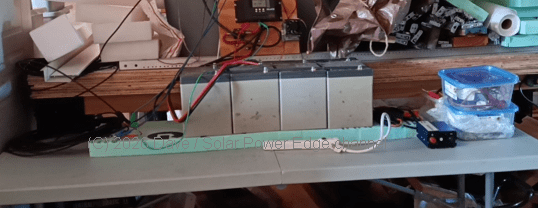
- A handful of lead acid batteries, modified square wave inverter and a 100w solar panel powering my barn
- Several small 100w 12v solar panels left over from my shop
- A shunt based battery meter
- Assorted cables, wires and hardware
- An enclosed area in my barn with a wall for mounting solar equipment
The lead acid batteries (recycled scrap from lawn mowers) were easily powering my barn (including LED lights, tools and topping off mower charge) but they lacked the power to really charge riding mowers. It’s worth noting that IF I was just pulling a trailer around and not doing any mowing, such a small system was totally adequate. That in and of itself is a testimony to what solar can do. Even hauling dirt and supplies around 35 acres is a massive capability when you can’t physically lift anything heavy. A single 100 watt solar panel can actually do that! Wow.
Power Storage – Finding A Battery
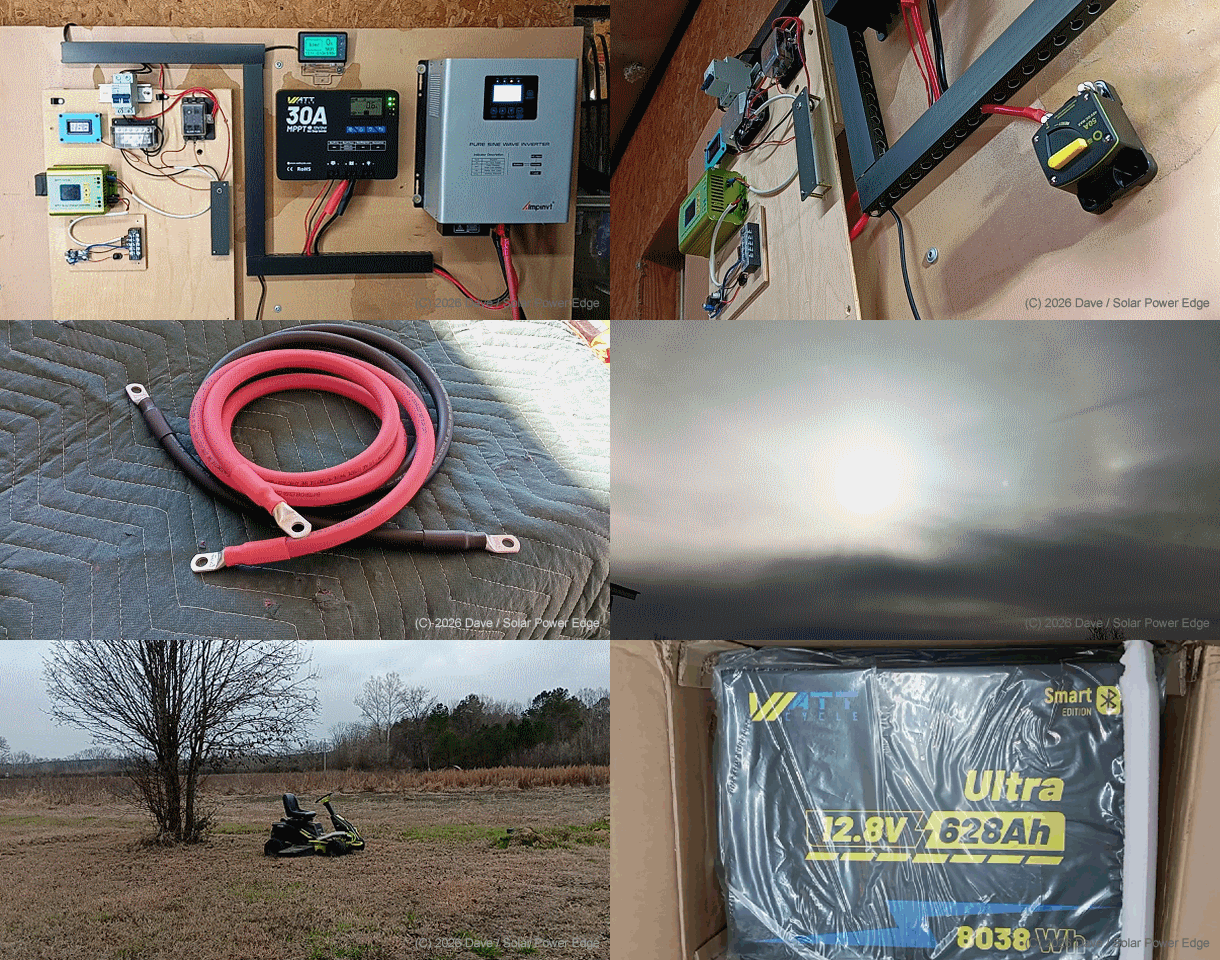
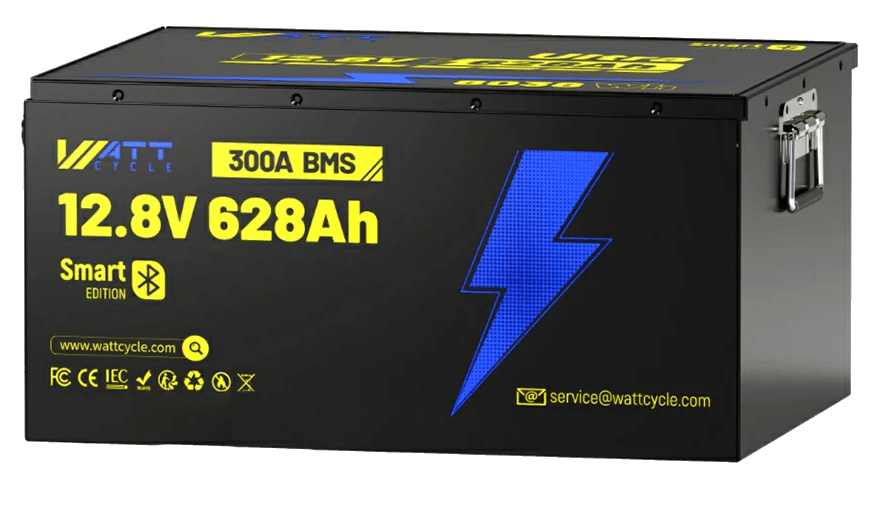
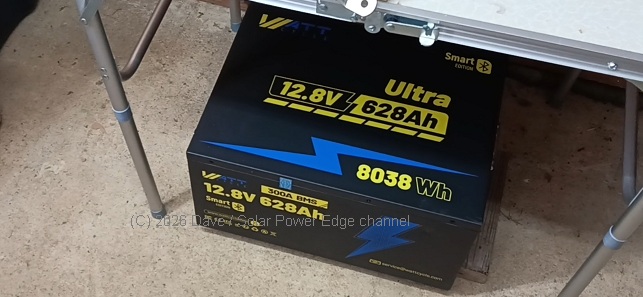
The solution later appeared… I was offered an opportunity to test a rather large LiFePO4 12.8v battery from a company called WattCycle. I accepted their offer to ship a sample battery in exchange for documenting the project on video. This could be the core of my new solar gas station. It was bigger than other 12v batteries I’d seen, at 628 amp-hours (direct link here). That’s about 8kW/h of electricity storage.
Behind The Scenes
Of course, such videos help demonstrate products in real-world use cases, which can be beneficial for marketing. My agreement with WattCycle was to make a video about the project and they’d send the battery (video is posted somewhere on this page). In fact the video took over 3 months to finally complete. I started working on this project even before the battery came onto the radar. Video production by a one-man-show in conjunction with ongoing projects is an incredible amount of work behind the scenes. Some people have seen these arrangements and tell me “I get stuff for free”. They are flat wrong. I go through more and work harder for it than they will ever understand or imagine.
Building My Solar Gas Station
Some months later, I finally received the WattCycle 628ah battery. To say it’s huge and heavy would not be an understatement. Quite an impressive piece of kit with it’s tough steel case and handles. Despite being very sick at the time, I managed to haul the battery out to my barn and ease it into position underneath a table.
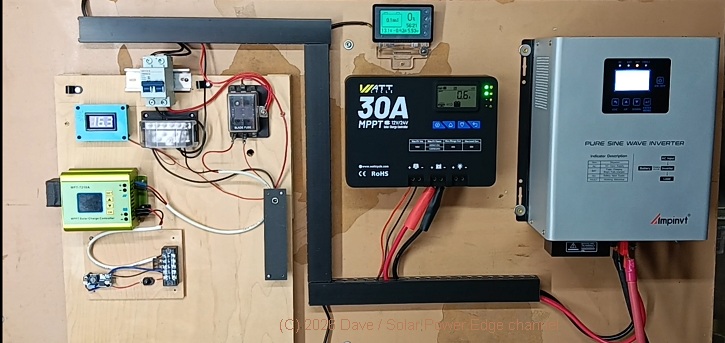
Somehow I managed to get a very heavy scrap board on the wall, alone and un-aided. Honestly that board was very heavy! Too heavy. I still remember fighting to hold it on the wall, get it level, and fasten it down. Then I chose and mounted a WattCycle 30a MPPT charge controller (I reviewed it earlier – on my YouTube channel). The inverter was mounted right besides and cables connected. Did I mention the inverter is heavy because it has a transformer inside? Yep. I took my MPT-7210a charging setup I used at the last property out of the shed and installed it on the board to share / re-use components, such as the PV circuit breaker.
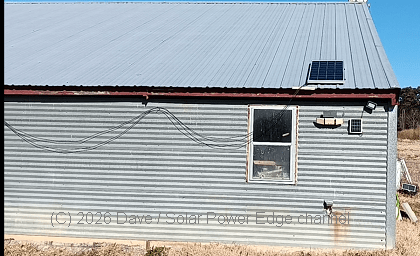
I had some magnetic 100w solar panels from my last workshop. I put one of those on the roof to test the system and ran a cable from the roof to the system inside the barn. By that time, it was winter and there wasn’t much solar to speak of. But the system powered up, charged and seemed to work at first glance. I already knew a single 100 watt solar panel couldn’t power those mowers enough to keep the grass under control. Later I stuck 2 more magnetic solar panels on my barn roof for a total of 300w theoretical. In reality, the best power I saw was approaching 170-200w, when the sun actually came out. It will get better by summer time…
To charge the mowers, I wanted to use direct DC. But my budget doesn’t permit that yet. So I used the OEM Ryobi chargers to convert from the AC inverter back to 48V DC. Charging the mowers with all those voltage conversions is easy, but terribly inefficient. For now, I will use what I have and work on the DC charging upgrade later.
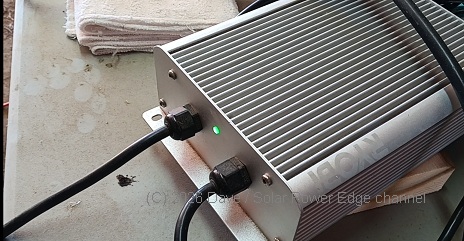
Solar is very easy to use these days. It usually just works. And this system was no exception. I turned on the inverter for a test, ran an extension cord out to the mowers, plugged in one mower to the charger, and watched the power flow into it. Piece of cake. No drama!
Update #1 – It’s now March of 2026. I have started using the system more due to the grass growing. And I tell you, it works well. Simple. The 300w of solar is constantly in the sun, it constantly charges, and by the time I plug my mower in there is several kW of energy just waiting to be tapped. It’s literally like a solar gas station. Wonderful!
Filling the 628ah battery with 300w of solar? Yes my estimates and calculations were correct. Getting at least a kilo-watt-hour per day is no problem in summer. Some days it’s more than that. Full charge is 100% possible, even with sub-optimal sun conditions. Scraping together only 3kW/h is enough to mow the entire front yard for the week. That said, I will consider expanding to 400w. Although that might make it too easy. With 3x100w solar panels, it is a bit challenging to balance 2 riding mowers. With a 4th 100 watt panel, charging push mowers, running lights, tools and the riding mowers should be possible and not even difficult. Time will tell!
Electric Mowers – Reluctant First Experiences
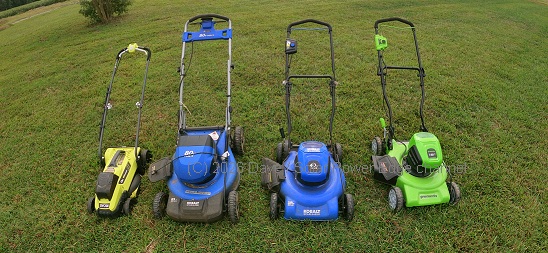
Several years ago, I gingerly stepped into the world of electric mowers by purchasing a Kobalt 80v push mower. (Blog post here). It was expensive. I had a lot of doubts. But the mower finally arrived, along with the extra 400$ battery I bought.
Within 15 minutes of using the mower, I was sold. And shocked. The power and runtime blew me away. I realized lithium-ion batteries and mowers are a match made in heaven.
Solar Mowing – Going All In
Not long after that, I totally ditched my gasoline powered mowers and went all in. I bought a Ryobi ZT480e 48v riding electric lawn mower with lead-acid batteries. I immediately tore apart and upgraded the brand new mower with Lithium Iron Phosphate (LiFePO4) batteries. This was very early on before anyone else had done such an upgrade. Unfortunately, this was before I was on YouTube. I never had a chance to make a video about it.
Anyway, the upgraded ZT480e mower was a real blessing – like a dream. It ran smooth, had a wonderful (but quiet) sound. Best of all, not ONE drop of gas, and not ONE oil change! The downside was the mower is a bit sensitive, must never get rained on, and it’s full of electronics. After several years of using the mower, I don’t mind taking extra care of it and it seems like a worthy trade-off. Did I mention no oil changes?
When Solar Power Gets Justified
And then another curiosity was satisfied: I started charging the mower with solar! That’s when I realized how powerful the combination of lithium batteries, electric mowers and solar can be.
Grass Mowing is generally a basic requirement of civilized society. It’s tough to maintain a property in a clean and organized state when the grass can move in and overwhelm it. Being able to mow endless grass with the power of the sun is surely a validation of what solar can accomplish.
I believe every household should own at least a single (or double) 100-Watt Solar Panel. A solar panel is the Swiss army knife of technology. It can do so many things it boggles the mind. Charging batteries, cooking food, ventilation, cooling/freezing, powering appliances, and that’s just the start. I’m not kidding. You should see what I have been working on 🙂 it gets even better. Hope to demonstrate some more advanced ideas and prototypes to the world as soon as possible.
In the meantime, check out my other posts and YouTube channel to see the projects I have presented thus far.
Thanks for reading this blog article and stay tuned! -Dave, SPE
 Solar Thoughts blog