I hear it all the time – 12 volts is weak. I don’t agree – it’s the thinking that is weak! ALL systems and voltage standards have their pros and cons. Part of what makes good engineering is carefully picking out the best of pros and cons – because there will always be both no matter what.
I have always heard that Low Frequency (LF) inverters OR inverter-chargers (the style of inverter which has a large chunky transformer inside) can surge to huge power levels on demand. And supposedly that even applies to 12 volt systems…
Note: I highly recommend watching my video of this inverter bench test (posted below on this page)
So can a 12 volt Low Frequency (LF) style inverter really have a strong surge, and start huge inductive loads on demand? That’s what is often said, but I never had a chance to test it for myself. A few months ago, the opportunity came. A company called SunGoldPower offered to send me their 12v 4kW LFP Series Inverter Charger for testing.
Disclosure: I did not get paid for this research. SGP shipped the inverter to me to use and keep. My agreement with SGP was to test the inverter using my own methods, document my tests, and show how I used the inverter as time progresses.
LF vs. HF Inverter Designs
What interested me about this LF inverter charger design is that it’s quite different from many typical off the shelf inverters – which are usually referred to as “high frequency (HF)” designs.
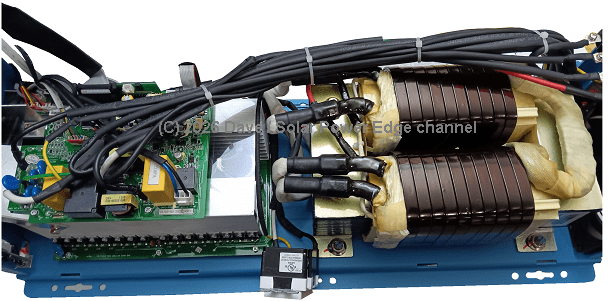
Note that this inverter, like most using a similar type of design, is very heavy due to the iron core transformer inside. But there are advantages to such a simplified topology. For one, isolation. The MOSFETs on the input are galvanically isolated from the AC load on the output (AC) stage. That eliminates certain concerns about bonding the neutral (a common concern with cheaper inverters is they will short out if their neutral and ground terminals are bonded), and ensures that the MOSFETS never see the AC load directly.
Without getting too technical, the MOSFETS sit “behind” the transformer and power the load “through” it. There are no switching components on the output side, which is merely a transformer secondary operating at a low frequency of 60Hz. This is an advantage, especially if there is an accidental short circuit on the output (AC) side. In that case, the MOSFETs themselves are isolated and the short circuit takes place on the other side of the transformer (its secondary) a scenario that might be advantageous in some cases.
The more common style of inverter (which I refer to here as the high frequency type) first boosts the low voltage DC to high voltage DC, typically using several small transformers and an H-bridge. It then sends that high voltage DC through IGBTs or MOSFETs on the output side to generate the modulated sine wave AC waveform – and this switching circuit is directly exposed to the AC load.
A Real Stress Test
It was several months before I was able to accept the inverter shipment and get this test done.
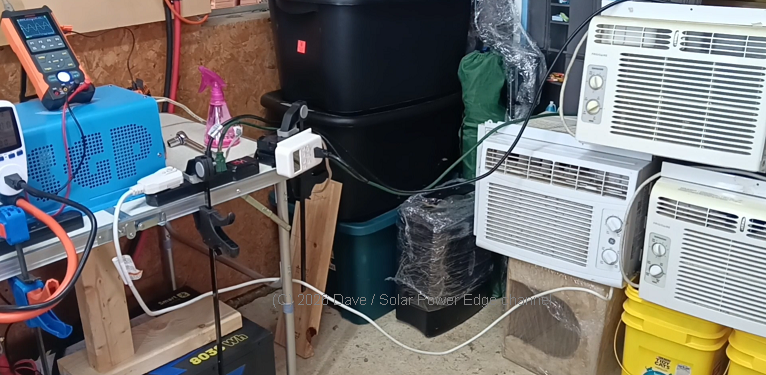
I prepared the following items for the test:
2x 0000 (4/0) AWG copper stranded power cables
1000+ Amp-Hour LiFePO4 12 volt battery bank
3x 5000btu Window ACs
1x Mitre Saw
1x Shop Vac
2x LED Shop Lights
1x 1500w AC electric space heater
An oscilloscope meter
And The Test Confirms It
I was interested to see what this inverter was made of.
At the start, I figured surely this tough inverter, being a real chunk of a machine, could start a couple of 5k BTU window ACs at the same time – right?? It turns out, that wasn’t even a challenge for it.
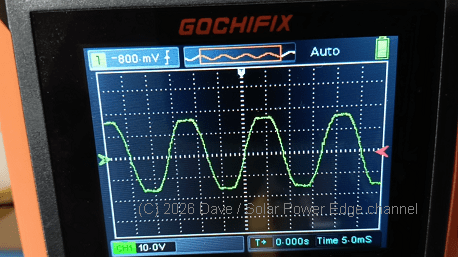
Long story short. The surge capability of the LF inverter design, even operating at 12 volts, was wholeheartedly confirmed without question. This inverter could not be stopped.
While already pre-loaded by 2 LED shop lights and a 1500w space heater, this inverter started THREE 5K BTU window air conditioners, a mitre saw, AND an 8 peak HP shop vac, ALL AT ONCE! And it did so repeatedly, over and over. It was not a random occurrence.
Even when deliberately causing the window ACs to draw LRA (locked rotor amps, due to pressure in the refrigerant loop), this inverter STILL started the saw AND shop vacuum – while still running the LED lights – and kept on running. Even while overloaded to 116%! To say the least, I was impressed.
So what made this test successful and ensured the inverter could surge properly? Answer: thick power cables and a well sized 12 Volt battery bank. I will write more on that subject at a later time – thanks for reading! -Dave, SPE
Video: My SunGoldPower 4kw LF Inverter Charger Test
 Solar Thoughts blog