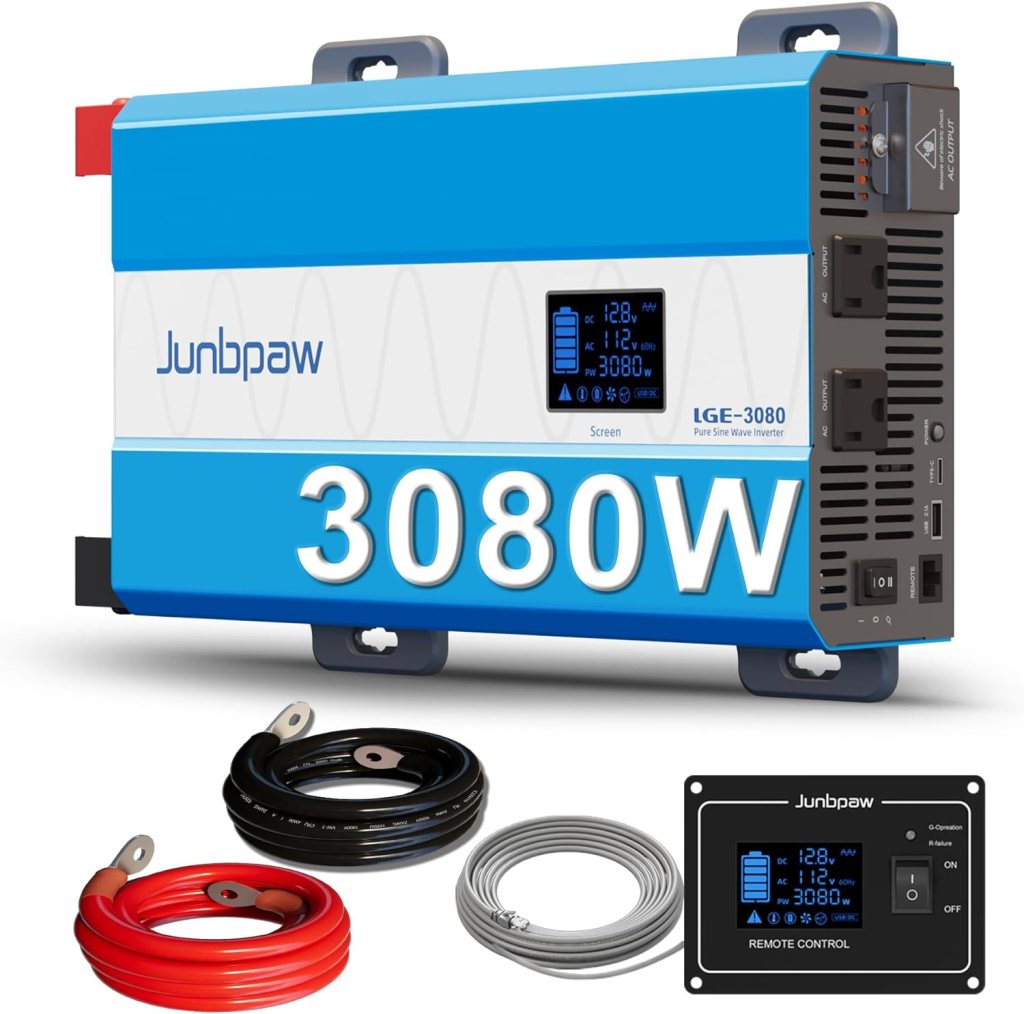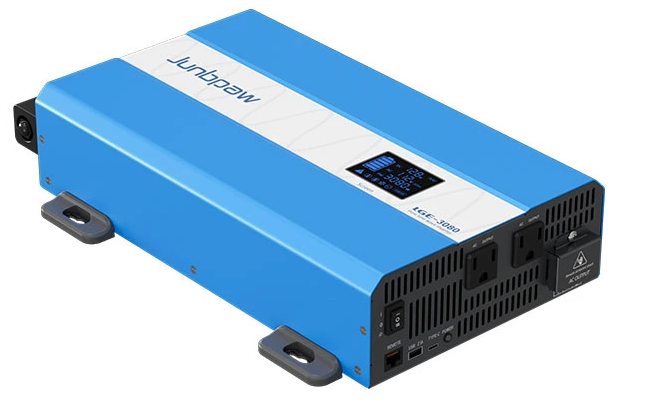
This is a detailed analysis, test and teardown of the Junbpaw 12v 3080w off grid inverter. According to the product listing on Amazon, this inverter is intended to be a unique design with several interesting advantages, including better quality and quiet operation. It retails for less than $200 at the time of this writing.
Like what I’m doing? Buy Me A Coffee on On Ko-Fi! 
Is It Really Quiet? Let’s Find Out
Its main feature is said to be that it’s QUIET, operating at under 40dB. I honestly have no idea if that is true – but I do have many other power inverters to compare it to. The 40dB noise level is supposedly comparable to a quiet library (sounds cliche) or a quiet rural area. Hmm, I don’t know, let’s just test it and find out…
Thoughts on the “Affordable” Power Inverter Market
I’ve always thought the affordable power inverter market could benefit from a slightly more advanced design and build methodology, without increasing the price too much. For example, why not address common failure points and complaints. Capacitors and MOSFETS are known for blowing up. Why not add a couple extra MOSFETs to share surge currents. Why not use solid state capacitors for example. And in fact, this inverter does indeed have some solid state capacitors. More on that later!
I love testing and reviewing inverters. In my mind, some of the most important things I want in an inverter have always been build quality, good design and longevity. Of course, if it’s quiet during operation, that’s a bonus. One of the most common complaints I hear about inverters is the FAN NOISE. And I completely understand this, especially as someone who gets panic and anxiety attacks. Hearing a fan cycling on and off for hours at a time, is just not helpful at all….
Standby Power Consumption
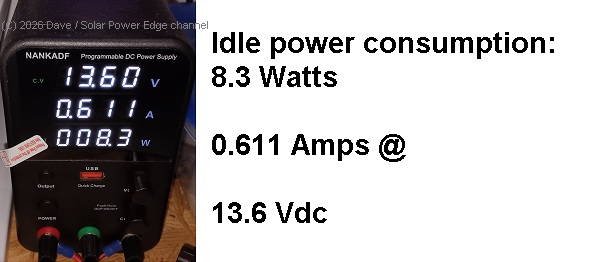
I started by checking the idle (standby) power draw / consumption. All DC-AC power inverter designs have varying standby power requirements. This impacts system efficiency. The question is, how much electrical power is wasted when the inverter is turned on, but not powering any AC loads. A lower standby power draw is very desirable. Total standby power draw on this inverter at 13.6V DC was only 8.3 Watts. Nice for a 3kW inverter!
Integrated and Remote Display
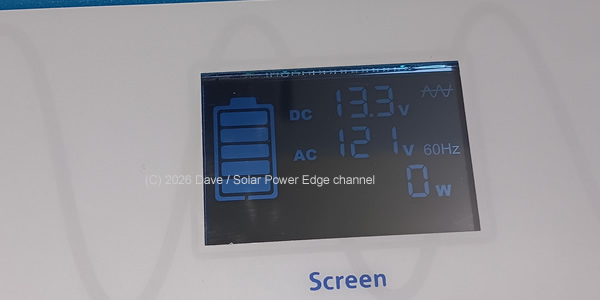
The top of the inverter has a built-in display screen that’s simple and easy to read. It shows the DC inout and AC output voltage, fan status, and total wattage in real time.
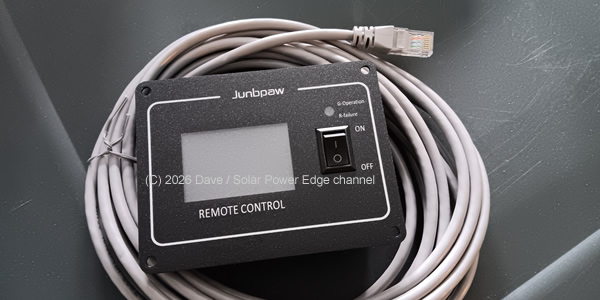
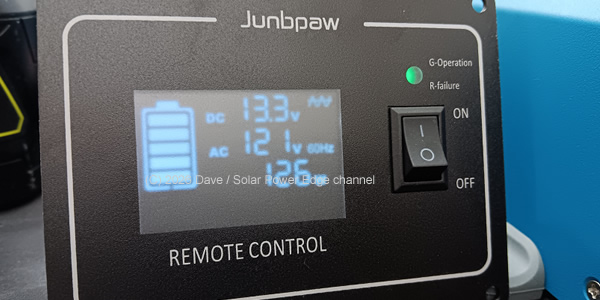
The included remote display is simple and clear, and uses an included (and generously-long) standard Cat-5 Ethernet cable to make the remote control connection.
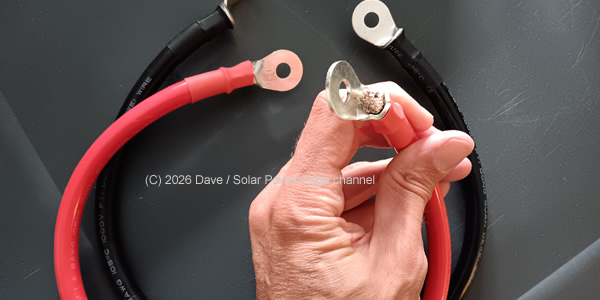
The included 12V DC power cables are surprisingly thick, marked as 2AWG and are clearly true stranded copper, with cold crimped ring terminals.
Looking Inside The Inverter
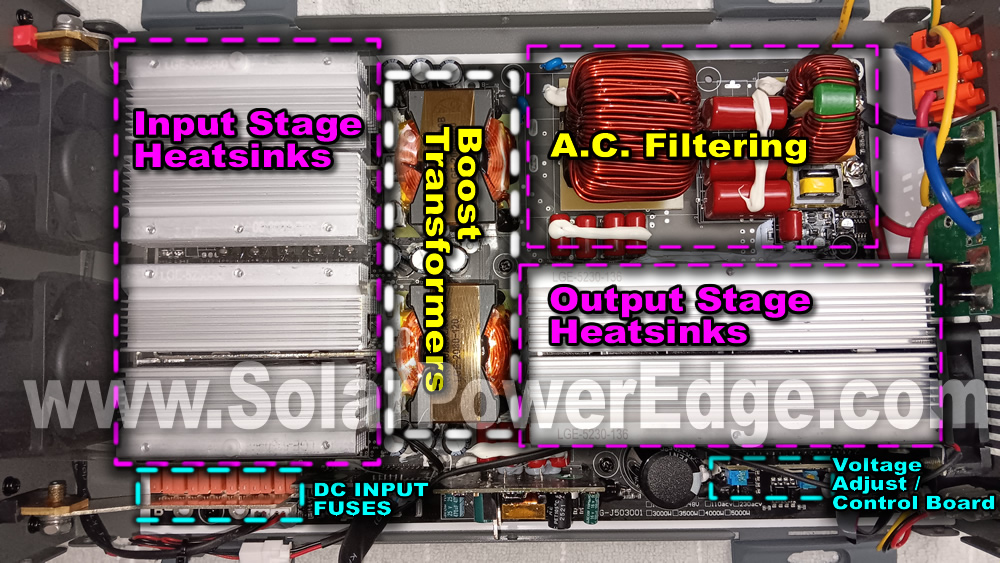
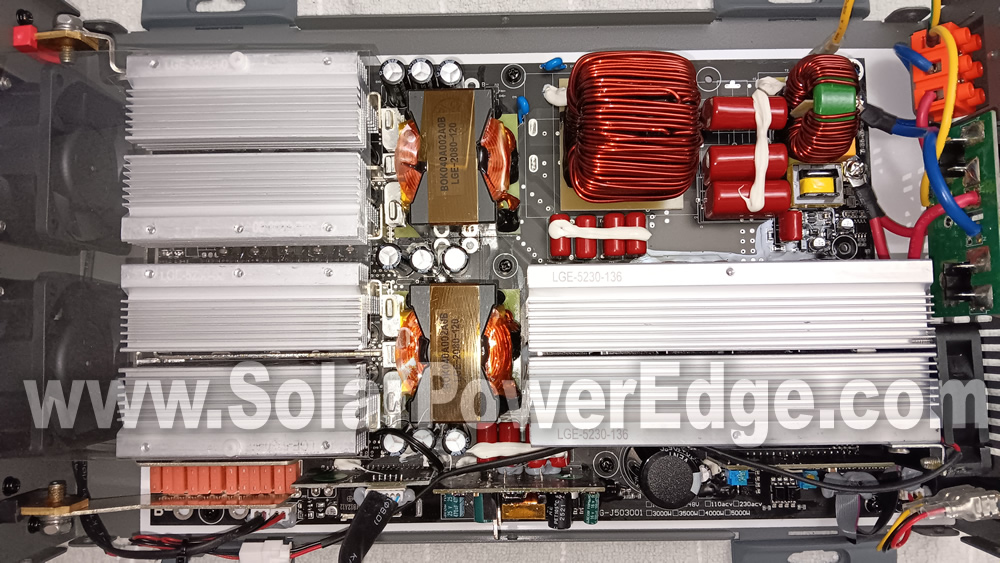
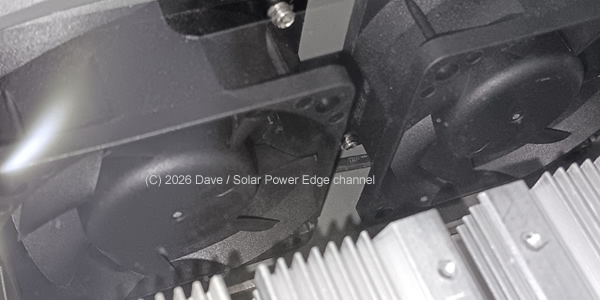
After removing the screws and opening the case, a rather clean looking circuit board and layout is revealed. It bears more resemblance to a PC motherboard than an inverter. I was immediately impressed. This type of design has internal heat sinks instead of using the case itself to dissipate heat. We see 3 small brushless DC fans for cooling. I am not sure how these will factor into the “quiet” designation of this inverter, but we’ll see.
DC Bus Bars
One interesting design choice in this inverter is the use of bus bars (instead of wires) to feed the low voltage DC onto the circuit board. This is pretty uncommon in affordable inverters and can raise production costs.
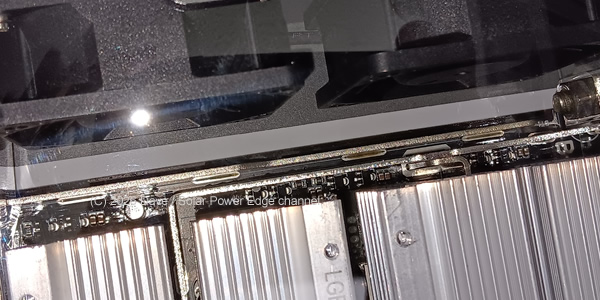
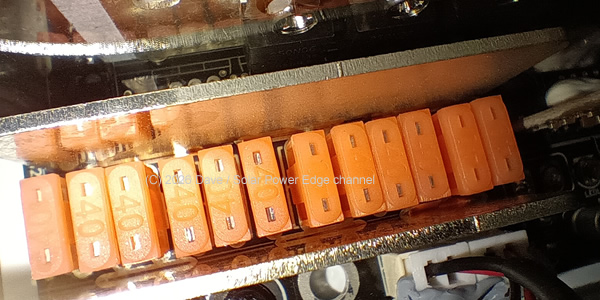
There are 12 pieces of 40 Amp DC automotive-type fuses on the PCB. An inverter should always have an external fuse, but these fuses are typically added as a last resort and protective measure when all else fails. Seeing that many fuses (480 Amps total) on the board tells me the engineers consider about 6,000 Watts to be the maximum load this inverter should be under. Basically, that allows a theoretical 100% surge rating (twice the 3080w power rating). Although I’d prefer not to push a small inverter that hard, such capacity is indeed impressive.
Solid State Capacitors
And yet another interesting choice: solid state capacitors. I was suprised to find these on the circuit board, as they cost more. But solid state capacitors are generally a much better choice for long term use, because they can last much longer and don’t have the “dry-out” problems of standard electrolytic capacitors. They can take higher temperatures and offer better ESR (equivalent series resistance, a measure of how easily power flows in and out of a capacitor).
There are still many electrolytic capacitors on the board, including for the bulk input capacitance. Standard electrolytic capacitors tend to dry out, and often they just inexplicably fail by going short circuit and exploding. Even though the entire board doesn’t use solid state capacitors, it’s still nice to see any all within this price level.
Flat Wound Laminated Transformers
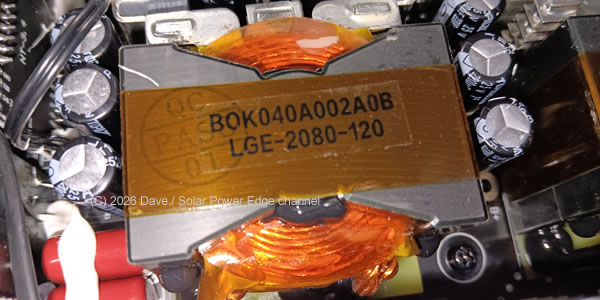
Upon opening this inverter, I was amazed to find flat wound laminated transformers! I am surprised at this detail. These types of transformers are more efficient and might be why the standby power consumption is so low. I rarely, if ever, see these parts used in what I would consider an “affordable” off grid inverter.
So far, it does seem this inverter is a step up from most I’ve seen in this price range.
Connectivity and Ports
On the front of the inverter is a terminal strip for wiring it directly into a 120V AC load center. I checked the wiring between this and the AC outlets on the front, just to make sure they were not mis-wired as is often reported on budget inverters.
Although we don’t usually buy inverters for USB ports, this inverter has a type-A and type-C USB port provided on the front. They are handy to have, and the USB-C had no problem powering my USB soldering iron.
Remote Display
This blue 3080w model comes with a remote display panel with remote power switch. This is one of the best features for installations where the inverter will be mounted in a hard to reach or out of the way location. The display is straightforward and easy to read and understand.
Bonding Ground and Neutral
This inverter does not have the Ground and Neutral AC outputs bonded or tied together out of the box. However, I did a quick check and it can handle having the Ground and Neutral terminals tied together, this should not harm the inverter. (Some inverters don’t like this). By the way, there is a video on my YouTube channel about how to test this on any inverter – without damaging it.
And A PROBLEM Is Found…
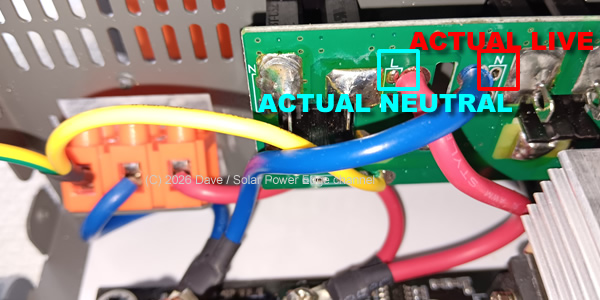
Unfortunately, I discovered the AC Live and Neutral connections on this inverter’s outlets were wired backwards. It appears the Outlet PCB was mislabeled on the silk screen, leading to the wires to be swapped during assembly.
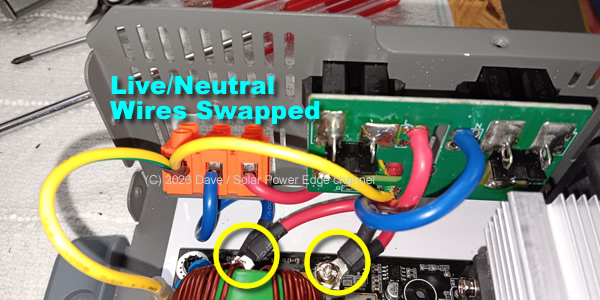
However, the fix takes 10 minutes. The solution is to swap the wires feeding the AC outlet board. I managed to do the swap while still recovering from a migraine, so that means pretty much anyone with basic “electrical DIY skills” should be able to handle this minor repair 🙂
Below are BEFORE and AFTER pictures where you can see the wires swapped:
BEFORE
AFTER
Brushless DC Cooling Fans
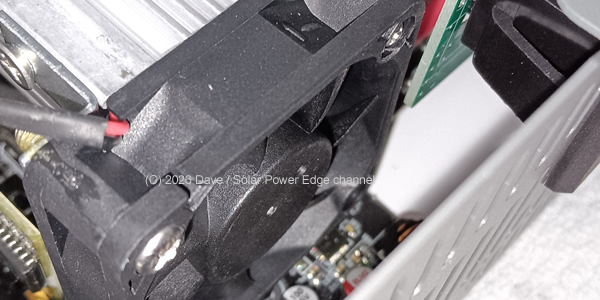
This inverter has 3 brushless DC cooling fans, 2 on the back and one inside, on the output stage heatsink. I will be curious to see how these sound when the inverter is in operation.
Switching Components
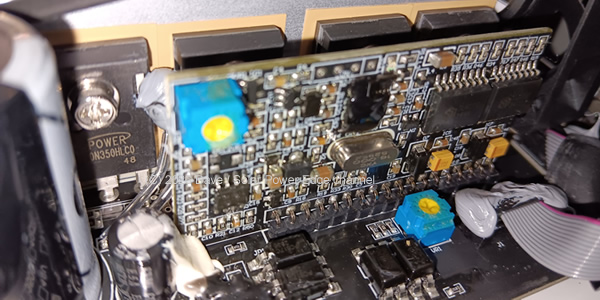
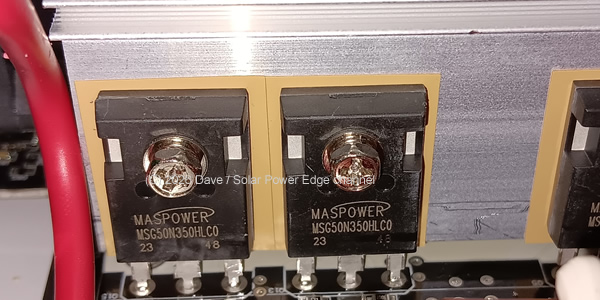
On the output stage of this inverter, we find several very beefy looking IGBT transistors MSG50N350HLC0. I am glad to see them and hope they can handle the upcoming stress test successfully…
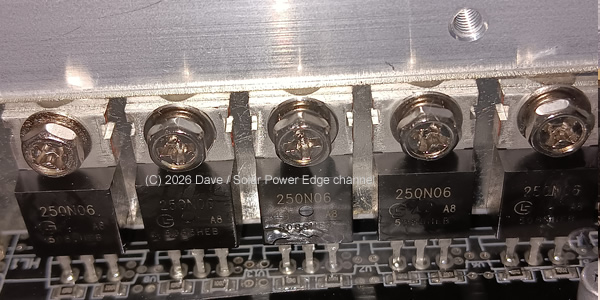
And the DC input side of the inverter uses standard looking MOSFETs 250N06:
Long Term 24×7 Testing Scenario
(Long Term testing updates are at the end of this article)
To really test and off-grid inverter, a 15 minute trial is not enough. What I want to see is if the inverter can survive punishing, real-world operation 24 hours around the clock, month after month. To that end, I have prepared the following test scenario:
First, we already operate an existing 12-volt off-grid system to power the house at our new homestead property. So I connected the Junbpaw 3080w inverter to that system, and migrated household loads over to it that we use every single day and night. This makes for a challenging and true real-world test with a mixture of different loads (such as resistive, capacitive and inductive).
The Loads We Tested
At the very minimum, this table specifies the AC household appliances we used for the duration of the test, I will update the table if others are added:
| Primary Loads | |
|---|---|
| 8000btu & 12000btu Inverter Window Air Conditioner | 2x “bug zapper” lights |
| 500w compressor dehumdifier | True HEPA filter |
| 2x Chest Freezers | LED Lighting |
| 1200w toaster oven | 1700w Air Fryer Oven |
| Kitchen Mixer | AC Induction cooktop |
| Upright Vacuum cleaner | Power tool battery charging |
Test Part 1 – Sine Wave Stability, starting mixed and Inductive Loads
One of the primary loads we run 24×7 are freezers. While they don’t take much power to run, they have a significant surge draw when starting. And imagine if 2 freezers suddenly start up at the same time, while running other loads – the resulting surge can be quite significant. However this is a great way to see how the inverter handles surges.
I attached my oscilloscope meter to the AC output to monitor the sine wave output during these tests. Also powered by the inverter during this test was an AC box fan, lights, battery charger,
I deliberately set up the test so that the compressors on both freezers engaged at the same time, for maximum surge draw.
Below is an animated picture (3 frames) of the AC sine wave output while starting the 2 chest freezers. There was slight distortion, but nothing catastrophic. Meanwhile, the overall waveform remained almost entirely sinusoidal in appearance.
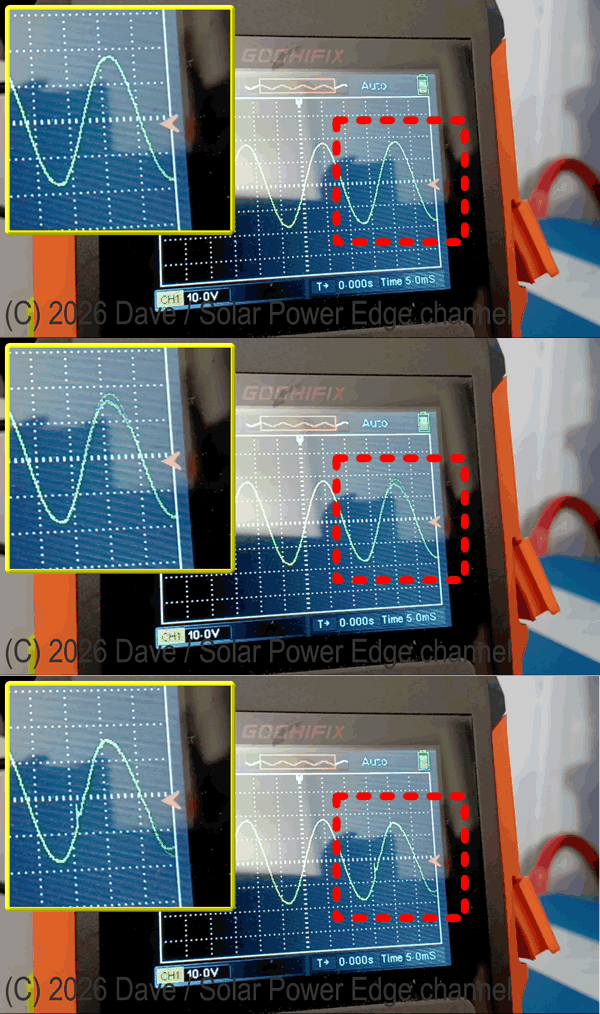
I did other surge tests at over 1kW+ power levels, and most of the time this inverter maintained a clean output waveform. My oscilloscope could not prove any notable distortion on the AC output. Another good mark for this inverter.
Test Part 2 – Air Conditioning, Efficiency and 24×7 Endurance Test
This is the long haul part of the test. Basically, I threw everything I had at the inverter, leaving it running around the clock with a mix of loads. This time, we also added a massive 12000btu inverter air conditioner to the mix, which tends to draw at least 500-1200+ watts and is really power hungry. These inverter air conditioners tend to have bad Power Factor (PF) and they can be a challenge to high frequency inverters, often causing harmonic and non-harmonic distortion on the output waveform.
Calculated Electrical Efficiency – Low Wattage
In this test, the inverter was loaded with a only a small PTC AC electric space heater and one lamp. Typically, high frequency inverters are less efficient when operating at power levels significantly below their maximum rating.
| Input (DC) | Output (AC) | Efficiency |
| 13.37 Vdc | 120.0 Vac | – |
| 21.34 Amps | 2.09 Amps | – |
| 1,177.392 Watts | 250.5 Watts | 87.8 % |
Calculated Electrical Efficiency >50% Rated Continuous Load
OK now I’m just straight up IMPRESSED with this inverter. The efficiency reached 92.5% and that’s good enough for me. Also, the fans came on, but they are not very loud – nor annoying. In this test, I ran a compressor dehumidifier, 2 space heaters, and a lamp.
| Input (DC) | Output (AC) | Efficiency |
| 12.76 Vdc | 119.0 Vac | – |
| 133.80 Amps | 13.27 Amps | – |
| 1678.048 Watts | 1,579.0 Watts | 92.5 % |
Did This Inverter SURVIVE? Is It QUIET?
This inverter has been working 24×7 day after day running our mix of household AC loads, without a single issue. It has survived the test so far. Testing will continue even after this article is published. I normally test inverters for several months minimum – well beyond a normal review or write-up.
As of the writing of this article (April-May 2026), the long term test is still ongoing.
Nearly every inverter I’ve owned had loud fans, some were more tolerable than others. But the Junbpaw 3080w inverter breaks the record – it’s the quietest, most peaceful inverter I’ve ever owned. At power levels of a few hundred watts, the fans do come on, but they have a low, rushing sound. It’s very different from my other inverters.
I don’t have a Decibel meter to track the sound level, but I don’t need to. Functionally it’s the quietest inverter I own and that means a lot. So I think Junbpaw’s claim of creating a quiet inverter is true.
Final Thoughts and Summary
I’ve installed, worked on and tested a LOT of inverters in my history, and after a while they all start to blur out and look the same. But when doing a review for the public good, and also with past experiences in mind, there are certain key things I look for. Three of which are: longevity, build quality and intelligent design choices.
This inverter is priced to be pretty affordable, yet definitely positioned as a more premium option compared to most budget-concious power inverter options in the market segment. And I wholly support that tradeoff. The internal electronics design choices certainly reflect an intent to outqualify other more cheaply built inverters. Solid state capacitors, copper bus bars and flat wound transformers are supporting evidence. I like those choices and think it reflects well on the overall package the inverter brings to the table.
The higher build quality and better component choices should enhance longevity. I will flate out state that the PCB (circuit board) in this inverter has to be the cleanest I have ever seen in this price range. I hope it lasts a long time.
Performance of the inverter was good under a mix of household loads. I was not able to find any particular defficiency. Keep in mind that our test scenario does not load the inverter to 100% capacity all the time. I tried to stay at 2/3 the rated continuous load or below. In reality, maxing out a power inverter all day is not the correct way to treat it in the long term. Loading by about half most of the time is a pretty reasonable way to ensure a longer lifecycle – and hopefully a good return on investment. Most commodity off the shelf inverters were never truly designed or intended to run at 100% for an extended time – no matter what the marketing materials state.
Anyway, this Junbpaw 3080w 12v inverter was able to handle an impressive continuous mixed load of about 2/3 its rated capacity, and the sine wave output remained stable like it should. I suspect this inverter runs “hot” due to the quieter fan arrangement, and I don’t yet know if that would impact the long term durability of this product. Only a long term multi-year test will confirm this.
I don’t regret owning and operating this inverter – it met or exceeded my expectations.
Long-term Test Updates
May 17, 2026 – hot weather has appeared. The Junbpaw is now running the 12,000btu air conditioner a lot more. The inverter is still running normal 24×7 loads including 2 freezers and other small appliances. We’re also powering both a toaster oven and air fryer oven simultaneously in the evenings to cook our food. Even while running the 12K AC, this inverter is able to power those 2 ovens and other small appliances – all at the same time. Under a 2300 watt load, the fan stays on constantly – but it’s the least obnoxious sounding fan I’ve never heard on an inverter. It doesn’t bother me. Credit where credit is due: this inverter has a thoughtfully designed cooling system.
Update July 13, 2026 – in July, we had a major summer heat wave in our area, with temperatures exceeding 100 degrees Fahrenheit. This inverter is capable of running not only our 12000btu air conditioner, but simultaneously an extra 6200btu window air conditioner with single-speed compressor and considerable startup surge. Plus the usual assorted loads. It handled sustained power draw in excess of 1,900w for long periods of time, with bursts to 2,500+ watts with no apparent issues. The fans can most certainly be heard running, but I don’t find them as bothersome as certain other inverters I own. This inverter is one of the few I’ve seen that truly use “preemptive cooling“. That’s why it’s so quiet. After 3 months of hammering this inverter, I can say with no reservation that I am truly impressed.
No affiliate sales commissions are accepted for these links. I am posting them here for your convenience. No strings attached!
Manufacturers Product Link (on Amazon)
Junbpaw 3080w 12v Sine Wave Inverter LGE-3080
https://www.amazon.com/dp/B0F2S2Z2BC?th=1
Hopefully, you found this article useful and educational. Thanks for reading! Dave, SPE