
Cooking food with only 10 watts of solar power sounds unattainable – but it’s not.
This was recently proved in my solar workshop. I used a combination of an insulated food container with a diode chain solid state heating element to efficiently extract heat from a solar panel.
The result is an ultra efficient mini and portable solar cooking device that can run off a 20 watt solar panel producing 10-15 watts.
I think it could very well set a world record for an efficient solar electric cooker. For reference, 10 watts is not much power at all – perhaps analogous to charging a cellular phone or running a small LED flood light.
Prototypes in Development
There are currently 2 prototypes in testing – a small (mini) solar cooker, and a larger one. This article only covers the mini-sized one. During one of the earlier tests with the small mini version, I was able to reach just shy of boiling point with less than 6 watts. (If I had kept it running all day, no doubt boiling point would have been reached. )
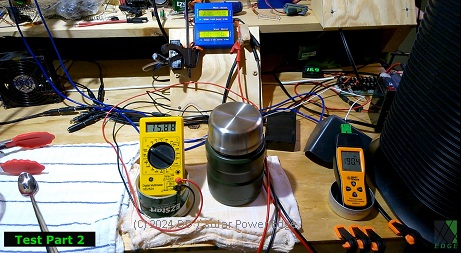
Cooking and egg with 10-15 watts of solar
However with slightly under 15 watts, water boils pretty quick. I then placed an egg inside, and successfully cooked it, using nothing but a 20 watt solar panel for power. Such a device opens the door to low voltage micro cooking devices and proves them possible to manufacture.
Even at 10 watts the device can cook, it just takes longer. At 6 watts, the device still worked, barely reaching boiling temperature.
Direct Solar Electric Cooking
I have been interested in direct solar electric cooking techniques for a while now. This is basically the idea of using a solar panel directly connected to an appliance to cook food – with no battery cycling or complex electronics. Unlike solar thermal cookers, solar electric means a pair of wires to bring the cooking indoors – out of the wind, sun and environmental conditions. This mini solar electric cooker is one of my latest iterations of the concept.

Applications
I believe that in the future, the world will need small, portable and efficient cooking systems powered by small solar panels. Battery backup should be an option. Devices like this are useful for remote areas where cooking fuel is scarce or hard to get.
Cooking can be done repeatedly for years, all day long with no fuel costs at all. Maintenance costs are low. Replacement cost shouldn’t be high, as the components are neither complex nor expensive.
Advantages of Diode Chain heating elements
While diodes chains (or diode strings) technically are electronic components, they are simple, cheap, easy to understand and effective. No complex circuitry is required to operate them. Because they keep the solar panel voltage up higher under a variety of conditions, it’s possible to stay near the Voltage of Maximum Power range (vMP) of the solar panel without any additional electronics.
Diode Chain Advantages vs. Resistance Elements
The diode chain acts like a regulator of sorts – it’s not perfect, but pretty good for such a simple concept. A bare resistance element, having a linear relationship between Current, Voltage and Resistance (I/V/R), cannot effectively regulate itself under changing solar conditions.
But the diode chain acts differently, and is able to roughly maintain a set voltage. As a result, a diode chain will extract far more heat (or watt hours) from the same solar panel versus a resistance element with no supporting electronics. With cooking, heat is what matters. Getting more heat out of the solar panel and into the food means more cooking can get done.
Summary
I believe there is a need and potential market demand for small, efficient mobile cooking devices that can operate from solar power.
Hopefully over time, small efficient solar electric cookers will become a reality and available on the store shelf. My goal is to simply raise awareness of these ideas, and push the boundaries of what people think is possible with solar power.
Thanks for reading and have a good day! -DD
Mini Portable Solar Electric Oven prototype
Mini Portable Solar Electric Toaster Oven prototype
 Solar Thoughts blog