It’s that time again… another solar powered experiment at the outer edges of “feasibility”. Part of my work and research in solar power the past few years has been about finding ways to do “more with less“. Often I try to accomplish a task using only the solar panel itself, using minimal to no electronics and low cost. This is what led to a lot of my “PV-to-Load” cooking and heating experiments.
Boiling water is a most basic and universal task needed all over the world. It is reasonably easy to boil water and cook food with a 100 watt 12 volt solar panel. This can be used for cooking, water purification or other tasks. I have built multiple ovens and small cookers powered by PV solar panels that work very well. Videos of them in action are uploaded to my YouTube channel.
Lately, I have been trying to use a 20 watt solar panel to boil water and cook food. That is exceptionally challenging – but sometimes possible.
Earlier in the first successful experiments, I boiled and cooked a whole egg using about 14w fed from a 20 watt 12 volt solar panel connected to a long piece of wire outside my shop. To keep the voltage from collapsing under changing conditions (no battery was used), a simple diode chain was used for the heating element. That project is linked here

Normally I try to focus on simple, robust solutions with minimal complexity in my research. The solution above used only a diode chain for the heating element. But some viewers of my YouTube channel suggested I investigate induction for cooking. Not long after, I encountered a small 10 dollar circuit (ZVS Induction Board) and just had to buy one to test. For 10 bucks, I can’t even make one. The component count is low, it isn’t that complicated, so why not give it a try.
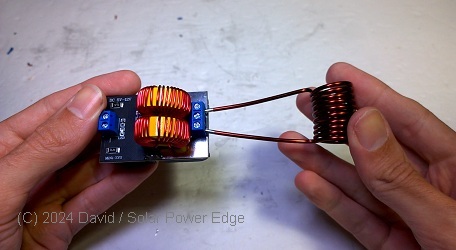
I would not consider this type of board to be very efficient on an electrical basis. Diode Chains (Diode Strings) are far more efficient at converting solar electric power directly to heat. Even a standard Ohmic (resistance) heating element seems it could do a better job than a ZVS board.
Surely induction wastes power, yet it accomplishes its goal in a very effective and interesting way. Efficiency should be considered from an overall perspective. How easy is it to use, how effective is it, what problems does it solve – one might forgive a few wasted watts in exchange for something that works really good.
Unfortunately the net impedance of this circuit is pretty low. I needed something in between the ZVS board and the 20w solar panel to address the impedance mismatch. That would be a DC-DC converter (buck converter) with constant current. I used it to adjust the amount of current flowing from the solar panel to the ZVS board in real time – similar to a MPPT (maximum power point tracking) circuit. With proper adjustment, I was able to squeeze about 14-15 watts out of the tiny solar panel into the experiment.

But some of that power is lost to heat in other places besides the water being heated. It’s just the way it is. The induction coil induces an electromagnetic field in a piece of metal inside the tube. But it’s a fact that the coil itself and the circuits produce heat – my guess is only about 10 watts of the heat actually makes it into the test tube in this case.

In short, this experiment was successful. The water boiled. There is no galvanic connection between the water being boiled and the ZVS induction circuit or induction coil. This is, in my view, a primary benefit of the technology. Typically with other solar powered heating elements, one must find a way to expose the water (and often food being cooked) to the heat, without causing contamination, electrolysis or damage to the heating element. In addition there has to be at least 2 wires connected somehow, this can be challenging to do. Induction neatly bypasses these problems.
This concluded the experiment for the moment. It answered a few questions I had.
Work has been slow, but I am still developing further solar powered prototypes in my shop and hope to present those soon.
Hope you enjoyed this article – thanks for reading and have a good day! Dave / Solar Power Edge
 Solar Thoughts blog